Recently many students have asked about transitioning from STEM to business, so we’ve impishly (yet thoughtfully) launched a new column on Zhihu:
4W1H
to have Zhihu guru CheersYou(清柚教育) Bro answer everyone’s questions about various majors.
For the first interview, CheersYou(清柚教育) Bro invited his good friend: superstar application mentor and one of the CheersYou(清柚教育) founders — Tony, to answer the many recent questions about IE (Industrial Engineering).
Background Introduction:
Tony holds a Master’s in Industrial Engineering from NYU and previously worked in the NYU admissions office. Coming from a STEM background, he switched to IE and later entered the business world. His personal journey and background make him a quintessential example of a tech guy transforming into a business elite. We had in-depth discussions with him on the topic of transitioning from STEM to business, which is highly relevant for STEM students looking to switch to business.
He loves working out and flirting on Blue, and an evening run in Central Park is the happiest moment of his day. His dream is to be bulkier than Lazar (we agreed to be refined elites together, yet you went ahead and got buff first). Although he always claims to be low-key, he never misses a chance to get famous. Here’s a link to his interview: http://www.niuschools.com/article/contents/id/1636, (feel free to check it out).
Warning: Hardcore insights ahead. Please read on patiently.
Why IE
Q: Currently the hottest business major in study-abroad circles is BA, right? What’s your take on that?
A: “I want to apply to BA” has become something of a slogan.
BA is indeed very hot right now. Since I started my business, I’ve worked with a lot of applicants, and they often don’t have a deep understanding of analytics. I’ve found that most BA applicants come from STEM backgrounds — math, physics, chemistry, environmental engineering, biology, and related fields. Their reason for applying is that they’re not interested in further study in their original field and want to try a business direction — what we call transitioning from STEM to business.
“Why is BA so popular?” I think it’s because STEM students find arts and business majors like HR, PR, Marketing, etc., insufficient in quantitative and technical aspects, which makes them seem “soft,” and these majors generally don’t fall under STEM, so job prospects aren’t great. But BA combines both business and quantitative skills, so it’s been widely embraced by STEM students.
BA is hot, but it’s not for everyone. Its popularity has caused many to overlook other traditional programs and majors suitable for STEM applicants. Take Industrial Engineering (IE), for example — a traditional strong program that has been neglected. In fact, IE is perfect for STEM students with business aspirations, and as an engineering major, it effectively avoids the disadvantage of competing against pure business students in BA, making it a privileged major for STEM students.
Q: Based on your understanding, what does the Industrial Engineering major really look like?
A: As a veteran with 6 years of IE study, I’d say the core essence of Industrial Engineering can be summed up in one word: optimization!
The classic case IE professors love to cite is Toyota’s production speed: at full capacity, they can produce a car in under 10 minutes. While that speed is impressive, what’s more astonishing is the tight collaboration with every upstream and downstream supplier and the high level of global coordination required to achieve such efficient capacity.
Another example: Apple’s global store inventory turns over every 5 days — meaning Apple warehouses achieve a turnover rate of 73 times per year! Only when a company forms extremely close partnerships with suppliers, builds a flawless supply chain network, and accurately predicts regional consumption can it achieve such seemingly impossible inventory management. Apple opened the world with Jobs’ products, and Tim Cook’s operations solidified the empire. (PS: Apple CEO Tim Cook has an IE background.)
The core optimization logic of Industrial Engineering goes beyond operations; it encompasses human resource management, infrastructure planning, industrial system optimization, corporate financial management, even down to individual customer preferences, work interface design, and every business negotiation — all involve optimization!
It can be said: Leave no stone unturned, plan every move. A brilliant industrial engineer in ancient times was like a prime minister by the emperor’s side or a strategist by the general’s side — constantly thinking of solutions or on the way to solving problems.
Q: What prompted you to choose this major?
A: Whether it’s Wikipedia or Baidu Baike, the definition of IE leaves people baffled. I sure didn’t fully grasp it during my four years of undergraduate study. So why did I choose IE in the first place?
In 2008, I took the Jiangsu college entrance exam, the year of Jiangsu’s exam reform. I was “honored” (frustrated) to be among the first batch of “new gaokao” students. When it came to choosing a major after scores were released, I was clueless. After 12 years of schooling with no exposure to the real world, how could I know what to study? Luckily, the president of a well-known university guided me. He asked me three questions:
— What subject do you like most? — Physics, biology, geography, chemistry
— What do you want to do in the future? — Be my own boss
— Who do you admire most? — Akio Morita (Sony co-founder), Thomas Edison
— Then study Industrial Engineering.
I have to admit I didn’t fully get it in college, and many around me didn’t grasp the essence of IE either. It wasn’t until after grad school, when I started my own business, that I realized this major is hugely underrated. Rather than seeing Industrial Engineering as a stepping stone to a job, think of it as a supreme inner art. Only when you’ve accumulated practical experience and the ability to leverage vast collaborative resources can you truly unleash its full power.
Every day since I started my business, these concepts have guided my work: system optimization, critical path method, capacity expansion, lean production, quality control, ergonomics, enterprise information systems management, engineering economics, project management, and more — all these concepts flash through my mind daily. Whenever I encounter a real-world puzzle, I can always find an IE discipline or concept to explain or summarize it.
Q: You speak so highly of IE. So what are the advantages of choosing this major in the U.S.?
A: What sets Industrial Engineering apart — and is also its highlight — is that it has many sub-branches, and each school offers IE degrees in different directions. Applicants can choose schools and directions based on their study interests.
Let me give an example of a U.S. IE program I highly recommend.
Columbia University: The entire department is built on Operations Research. It not only offers Financial Engineering but also Management Engineering. Financial Engineering is harder to get into, while Operations Research and Management Engineering are relatively easier, with Operations Research having the largest enrollment.
Department of Industrial Engineering & Operations Research offers the following programs and degrees:
Master of Science in Management Science and Engineering
Master of Science in Financial Engineering
Master of Science in Industrial Engineering
Master of Science in Operations Research
Ph.D. in Industrial Engineering and Operations Research
Columbia IE’s advantage as an interdisciplinary field lies in its broad absorption of various branches and research directions. The four MS programs offer different concentrations, allowing students to choose based on personal interest and career plans. Take MSOR, for example: the same program provides multiple concentration options, so students can select and study courses aligned with different career goals, offering great flexibility in curriculum design.
-Financial & Managerial Applications
-Business Analytics
-Logistics & Supply Chain Management
-Optimization
-Applied Probability
-Entrepreneurship and Innovation
Q: Many people think a major’s value is all about employment. What’s your view?
A: A student who graduates from IE and doesn’t start a business is wasting this major’s greatest potential!
Industrial Engineering cultivates a global perspective, problem-solving skills, decision-making abilities, and system optimization. If one merely works as a quality engineer or in a factory’s production department, it’s a huge underutilization of talent! Yet fresh graduates lack the ability to step straight into management. So entrepreneurship is the most fitting path for ambitious, capable industrial engineers.
About 42% of U.S. corporate CEOs have studied this major. Market demand is strong: over 70% of graduates enter the industry as managers, department heads, industrial engineers, or mechanical engineers.
Q: As a senior alumnus, any application advice for juniors?
A: Let’s talk about IE admissions requirements first:
For Industrial Engineering programs, applicants typically need a GRE total score around 320. Top universities like Columbia require around 325. For those with lower GRE scores, they can try NYU’s IE program, where a 315 might suffice.
Also, most schools require a GPA of at least 3.0 (on a 4.0 scale). Top programs like Columbia often require above 3.5. For lower GPAs, consider University of Tennessee, which requires only 2.7.
TIPS:
• TOEFL 90+ is sufficient; 100+ is needed for top schools
• GRE 315+, ideally with a perfect math score
• In your resume and essays, highlighting project experience is more effective than filling pages with internships
The above is Tony’s heartfelt take on Why IE. Below is the driest, most essential IE primer — you’ll want to chase it down with a glass of ice water. (Smile)
What is IE
Industrial Engineering is a discipline that designs, improves, and implements integrated systems of people, materials, equipment, energy, and information. It comprehensively applies specialized knowledge and techniques from mathematics, physics, and social sciences, combined with the principles and methods of engineering analysis and design, to confirm, predict, and evaluate the results achieved by such systems.
Specializations: What sets IE apart — and is also its highlight — is its many sub-branches, with each school offering different degree directions. Applicants can select schools and directions based on their study interests. Broadly, Industrial Engineering (IE) can be divided into four major areas: Human Factor, Manufacturing, Production and Management.
It also covers various sub-disciplines:
Concentration & Track
1. Project Management
2. Manufacturing, Production and Distribution
3. Supply Chain Management
4. Productivity, Methods and Process Engineering
5. Quality Measurement and Improvement
6. Program Management
7. Ergonomics/Human Factors
8. Technology Development and Transfer
9. Strategic Planning
10. Management of Change
11. Financial Engineering
Which school (where to choose)
School Selection Strategy
Location
Big cities offer more job opportunities — an indisputable fact. Moreover, the main employment direction for IE is industry, so industrially developed cities are the top choice. The Great Lakes region is the largest industrial base in the U.S. Chicago, Illinois, and Detroit, Michigan, are famous industrial cities; in the Northeast, Pittsburgh, Pennsylvania; in the West, Seattle; in the South, Houston and Dallas, Texas — all are notable industrial cities with many large manufacturing companies, offering good job prospects for graduates.
School Characteristics
Beyond location, an applicant should also consider a school’s unique features and research focus.
First, categorize schools:
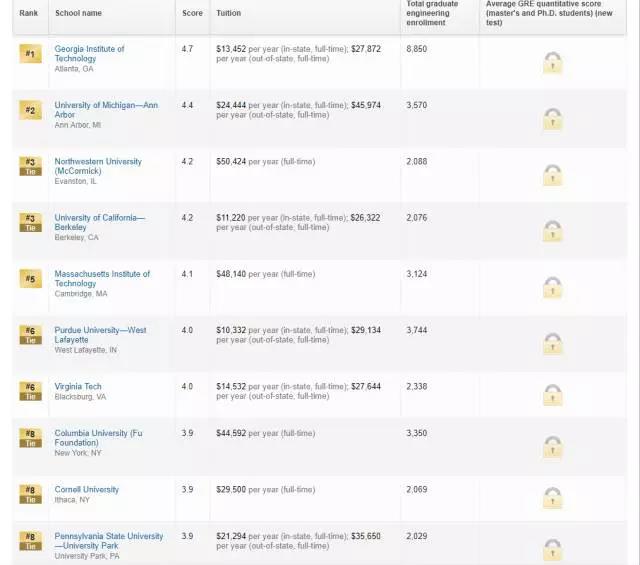
Top-tier IE schools:
Georgia Tech, UC Berkeley, University of Michigan–Ann Arbor, etc. These not only rank highly overall but also have outstanding IE research. Applicants need not only excellent test scores but also strong academic backgrounds and abilities.
Prestigious schools with moderate admission difficulty and sizable enrollment:
Columbia, USC, Cornell, etc., fall into this category. Compared to other schools of similar prestige, they are relatively friendlier to Chinese students, have larger cohorts, and are easier to get admitted to, especially for MEng degrees. Admission difficulty is lower, making them suitable for applicants with less stringent requirements or a desire for a big-name school.
High-quality schools with moderate difficulty:
TAMU, Ohio State University, Iowa State, University of Minnesota–Twin Cities, etc. These have average overall rankings but high program rankings, with moderate admission difficulty and excellent program quality.
Where to go after graduate
As mentioned, IE offers a wide range of employment. Here are possible fields:
• Banking
• Consulting
• Entertainment
• Insurance
• Medical Services
• Military
• Retail
• Transportation
• Entrepreneurship
Career Paths
Industrial engineering consultant, production manager, plant manager, safety equipment engineer, systems engineer, materials manager, production operations analyst, process engineer.
Consulting firms — market research, industry consulting.
Government civil servant — economic management.
University faculty — teaching and research.
Countries like the U.S., Japan, the Four Asian Tigers, and Thailand have all treated IE as a major tool for economic development, and IE technology has flourished accordingly. Compensation for IE graduates is generally above average. Starting salaries are relatively high: master’s graduates can earn over $60k, PhDs over $80k. Thus, this is a very promising field.
How to apply IE
Admissions Requirements
Language tests: Some schools don’t accept IELTS, so TOEFL is recommended. IE doesn’t have a high TOEFL bar; 80-85 is usually sufficient, but for top schools, aim for 100+.
GRE: At least 300. For top-100 schools, aim for 310+, even 320. IE doesn’t require GRE Subject tests, but if applying to an OR direction (Operations Research), consider taking the Math Subject test.
Academic Background
Since modern Industrial Engineering studies large-scale industrial production and socio-economic systems and has evolved from manufacturing engineering, management science, and systems engineering, it is a highly comprehensive interdisciplinary field. Therefore, applicants should preferably have some engineering or science background. Unlike typical engineering fields, IE applies social science and economic management knowledge, using engineering techniques to solve systemic management problems. Only with a solid engineering foundation can one systematically grasp the field and better learn the management aspects of IE. Note that IE heavily relies on mathematics: most research directions involve many mathematical methods, so a strong math background is strongly recommended.
Application Materials
• TOEFL/IELTS scores
• GMAT/GRE scores
• Resume
• 2-3 letters of recommendation
• Personal statement, essays
• Transcripts
• Financial proof
Admissions Procedure
Applicants must mail all materials by the deadline (which varies by school; closely monitor the official website, usually between November and January) and apply through the online system. Schools will notify accepted applicants by the published decision date and issue admission letters.
In summary, if you’re still hesitant about transitioning from STEM to business, I recommend considering IE. It has good career prospects, reasonable admission difficulty, and offers great value.