

When applying to graduate or doctoral programs abroad, especially in North America, most students encounter the two Gs, which puzzle some students, not knowing which one to take.
The two Gs are the two standardized graduate/doctoral entrance exams everyone has heard of: GRE and GMAT
GRE, short for Graduate Record Examination, is the U.S. graduate school entrance/qualifying exam. In the U.S., GRE scores are used as one of the rigid standards for graduate admissions and are widely regarded by schools as a standardized test to assess students' vocabulary, critical thinking, and logical analysis. It can be said that if your goal is to apply for graduate or doctoral programs in North America (U.S., Canada), then GRE scores are needed.
GMAT, short for Graduate Management Admission Test, is a standardized test specifically designed to assess the abilities of business school applicants. It was originally created for admission review of U.S. business schools, but nowadays many business schools in Europe and other countries also require applicants to submit GMAT scores.
We use a diagram to explain the relationship between GRE and GMAT.
(1).png?x-oss-process=style/opt-webp)
Simply put, the GRE has a broader scope of application than the GMAT, while the GMAT is more specialized, only for business school applications. In a nutshell: if you only want to apply to business schools, then you can take either the GMAT or GRE. If you are also considering other colleges and majors beyond business schools, it is recommended to mainly consider the GRE.
Question 1: Is GMAT a Must for Business School Applications?
The answer is both "yes" and "no". As the business school entrance exam, the GMAT and GRE were more clearly divided in earlier times. For candidates applying for an MBA (Master of Business Administration), the GMAT was a required score. But! As the GRE becomes more widely accepted, now many business schools accept either score, and applicants just need to submit the score they find most convincing.
For example, let's look at NYU Stern School of Business's MBA admission requirements; the official website states that applicants can submit either GRE or GMAT scores.
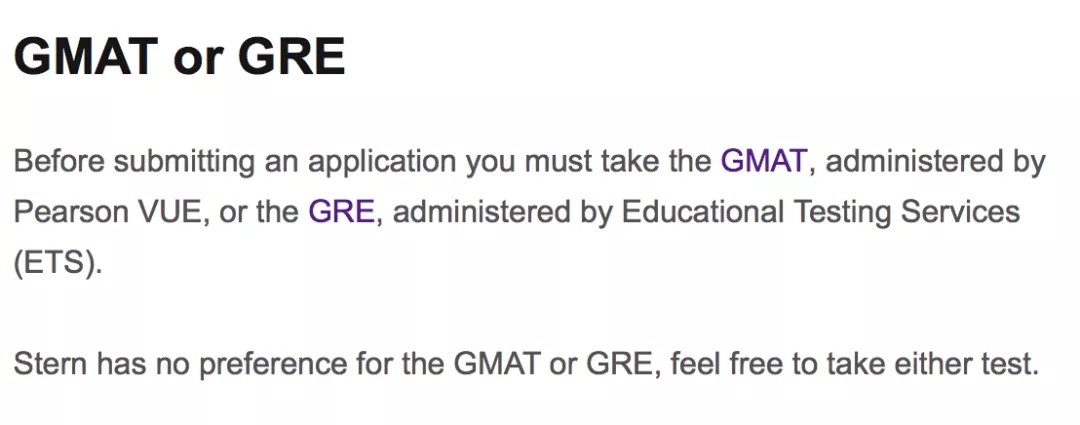
However, some university business schools clearly state that they only accept GMAT scores, such as Case Western Reserve University's Weatherhead School of Management:

There can also be some tricky situations, such as we found this statement on the Harvard Business School website.
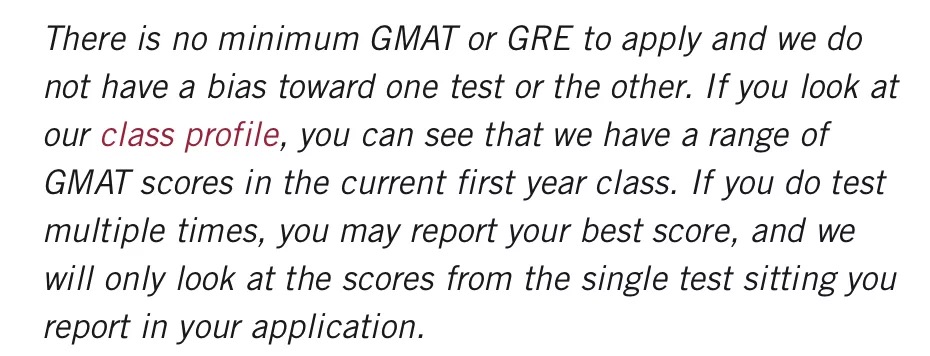
Although Harvard Business School clearly states that both GRE and GMAT scores are acceptable, reading between the lines, one can still see their preference for GMAT scores. It can be said that the higher ranked the business school, the more they prefer applicants to use GMAT scores. Therefore, before applying, you must clearly understand the schools you are applying to, have a comprehensive understanding of them, so you can make a decision.
To sum up: For students applying to non-business majors, prioritize the GRE. If you intend to apply to business schools, especially some prestigious traditional business schools, it is still recommended to take the GMAT.
Question 2: Since Many Schools Accept Both Exams, Why Should We Still Distinguish Between Them When Applying?
This brings us to the content tested by the two exams:
.jpeg)
If we have to talk about difficulty, the GRE is easier than the GMAT. The GRE is more of a test of perseverance and vocabulary mastery. In other words, as long as students have the patience to memorize GRE vocabulary and know some simple problem-solving techniques, it is possible and easy to achieve a desirable score on the GRE. Let's look at an example from the GRE:
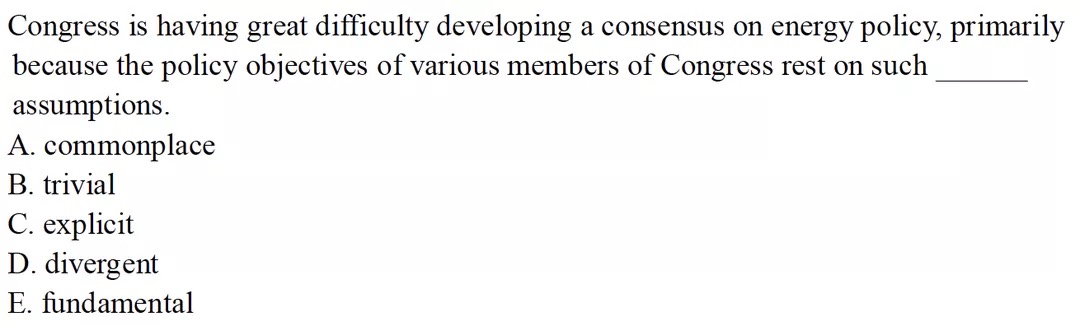
This is a fill-in-the-blank question from a GRE verbal section. It's easy to see that the sentence logic itself is not difficult; as long as you accurately grasp the meanings of the words, it's easy to score. But in the GMAT test, there is no vocabulary requirement; instead, there is a greater emphasis on logical reasoning, such as logic questions, reading comprehension, grammar questions, and reasoning questions. Moreover, GMAT math is much more difficult than GRE math. It is worth noting that the GRE has a broader scope of application than the GMAT. Some schools (such as UMich's Quantitative Finance program) clearly state that they only accept GRE scores.
Therefore, for majors like business that emphasize logical thinking, if a student has a weak math foundation but still wants to apply for business-related programs, it is easier to get a high score on the GRE. However, if you intend to apply to business school but dislike memorizing vocabulary, find vocabulary memorization difficult, and feel that you are strong in logic, you might choose the GMAT.
Question 3: Does Choosing GRE or GMAT Affect Your Application and Future Career Planning?
The answer is yes. Why, knowing that the GRE is generally less difficult than the GMAT and that most schools accept both scores, do some people still specifically take the GMAT? It is because, essentially, the GRE is more suitable for students who plan to focus on research in the future. It does not focus on one specific area but comprehensively assesses students' academic abilities. On the other hand, the direction and content of the GMAT exam are more aligned with business-oriented talents. Imagine, those entering business school are the future business elites who will deal with contracts and money. Especially in business negotiation situations involving millions, logical thinking and adaptability are particularly important. These are the abilities tested in GMAT questions.
We recommend that if your future application purpose is very clear, for example, you only plan to apply for MBA programs or some majors under business schools like accounting, then focus on preparing for the GMAT. This way, when you enter business school, you will find that the logic of the professors' lectures aligns with the thinking you developed during test preparation. If you have already decided to pursue a career in business, such as management consulting or investment banking, some companies may require job applicants to provide GMAT scores. In that case, having a GMAT score ready in advance gives you a significant advantage.
If you plan to apply to multiple directions and your major is not limited to business schools, we recommend taking the GRE. The math section is easier to get a high score, and with proper preparation, you can also achieve a good verbal score. This gives you a significant advantage when applying to STEM schools, as well as some majors under business schools, such as Business Analytics. For students leaning toward pure humanities and those with a weaker math foundation, the GRE is definitely the first choice.
Especially note: For students applying to Financial Mathematics and Financial Engineering programs, math scores are particularly important. Although the names contain "finance," these programs are usually housed under engineering schools and only accept GRE scores, not GMAT.
From this perspective, the choice between GRE and GMAT is something you need to start considering from the moment you decide to study abroad.
Question 4: GRE or GMAT: What Score Is Considered Enough?
It is recommended that GRE score not be lower than 320, and GMAT not lower than 700.
The score requirements for GRE or GMAT are not as straightforward. Although some schools may suggest what scores you should get in each section, most schools say that there is no minimum requirement for these two exams. Therefore, of course, the higher the GRE or GMAT score, the better. You can pay attention to ranking sites like US News, which update the average admitted scores for schools each year. More convincing is to connect with alumni and get the latest information from them.
Therefore, if language proficiency tests are a hard threshold, then having an excellent GRE/GMAT score will be like adding wings to a tiger in your application.
More specifically, GRE starts at 260, with a perfect score of 340, and Verbal and Quantitative each range from 130-170. Generally, a score of 320 can get you into top 60 U.S. schools, 325 can get you into better schools, and if you score above 330, you can apply to top-tier schools. But note that GRE is just a bonus; the threshold that determines admission is still your GPA.
GMAT's Verbal and Quantitative scores range from 0-51, which are converted to a total score of 200-800. Generally, a score of 660 can get you into average U.S. schools, while a score above 710 can get you into top schools.
Of course, schools will also holistically evaluate your background, experiences, and essays; a test score alone is far from enough.
Key Takeaways
.jpeg)
Many business schools accept both GMAT and GRE scores, but you must check the specific requirements on the school's official website. The higher the GRE or GMAT score, the better, but don't forget to improve other aspects of your profile.
Plan early, decide early, take the test early, apply early. Wishing everyone success in conquering the G exams and securing admission to your dream school!