
The GRE is a required test for admission to most graduate schools in the United States. Some programs may not mandate GRE scores, but they still recommend submitting them.
Canada, the U.S.'s neighbor, has even more inconsistent requirements for graduate applications. Most university programs do not require GRE scores, but some schools, such as business schools, do. Therefore, a common question troubling many applicants to Canadian graduate programs is: Do I need to prepare for the GRE or not?
Below, CheersYou(清柚教育) lists some majors and programs in Canada that require or recommend GRE scores to help students better plan their applications.
Master's in Economics
For applicants who completed their undergraduate degrees outside Canada and the U.S., most top-ranked Canadian universities require GRE scores when applying to Economics master's programs, and GMAT scores cannot be substituted. Examples include McGill University, University of Toronto, UBC, Queen's University, University of Calgary, Western University, etc.
Additionally, some Canadian universities like University of Ottawa and McMaster University, while not mandating GRE scores, strongly recommend submitting a high GRE score if your undergraduate GPA is not high; otherwise, admission will be difficult.

The U of T website states that GRE scores are strongly recommended, and applicants who did not complete their undergraduate degree in Canada must submit GRE scores.

McGill's website states that in addition to the requirement for non-Canadian bachelor's graduates to submit GRE scores, it also notes that GMAT scores cannot substitute for GRE scores.
Master's in Finance
Most Finance master's programs at Canadian universities require all applicants to submit either GRE or GMAT scores, unless they meet certain exemption conditions. For example, the Finance master's programs at the University of Toronto and UBC allow exemptions under specific circumstances.
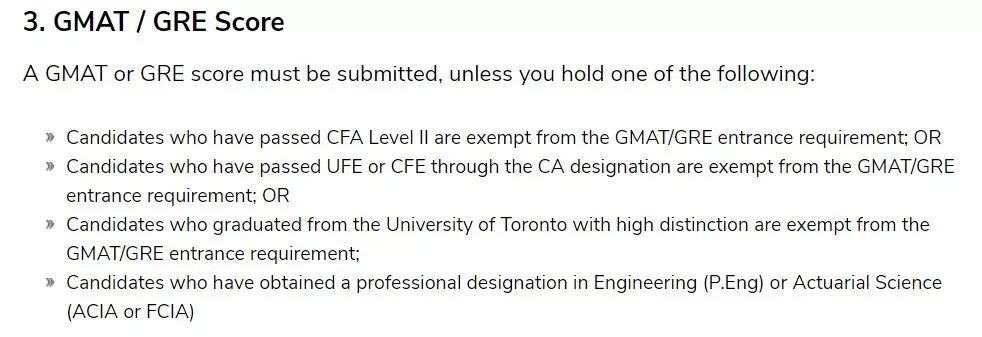
Specifically, the Finance master's program under the Rotman School of Management at U of T requires applicants to submit GRE scores unless they have passed CFA Level 2 or graduated from a highly relevant program at the same university.
For most applicants, the exemption criteria are very strict, and ultimately they still need to submit GRE or GMAT scores to apply.
Rotman School of Management Finance Master's Program
Requirements for GRE/GMAT Waiver
Master's in Statistics
Statistics master's programs in Canada are typically two-year programs. While GRE scores are generally recommended, they are not mandatory. For admissions, Canadian universities place high emphasis on applicants' undergraduate major, prerequisite courses, academic performance, and research experience.
Students with undergraduate backgrounds in highly related fields such as statistics, actuarial science, mathematics, economics, or engineering will be more competitive, for example, McGill's Mathematics and Statistics program.
Master's in Electrical Engineering
There are two types of electrical engineering programs in Canada: M.Sc. (thesis-based) and M.Eng. (course-based). Most students apply for the M.Eng. in Electrical Engineering. Most Canadian universities do not require GRE scores for electrical engineering master's programs, focusing instead on the applicant's undergraduate major and academic background.
It should be noted that while many schools do not mandate GRE scores, they often recommend submitting them, and the importance of the GRE is self-evident. However, the specifics should be analyzed based on program requirements and precedents.

U of T ECE Master's notes that GRE scores may be submitted

McGill University ECE Master's encourages submission of GRE scores
The GRE score is not just a cutoff; simply exceeding the minimum does not guarantee success.
For most schools, the GRE is an important reference point for measuring a student's ability, and different schools weigh this reference differently. Therefore, when preparing for the GRE, students need to tailor their preparation based on their target schools.