
Duke University Launches New FinTech Master's Program
Last week, Duke University announced a new Master of Engineering in Financial Technology (FinTech) program. This makes Duke one of the top U.S. universities to introduce this emerging field, following similar programs at institutions in the UK and Asia.
Duke's official introduction states: "At the core of every seamless financial transaction is FinTech. FinTech allows us to pay for coffee with a smartwatch, trade stocks on a mobile phone, and pay rent via an app while keeping our bank account details confidential. From Bitcoin to blockchain, FinTech is changing the way we think about financial services."
Duke's new FinTech program is jointly offered by the Pratt School of Engineering and the Duke Financial Economics Center. It will commence on July 29, 2020.
Curriculum:
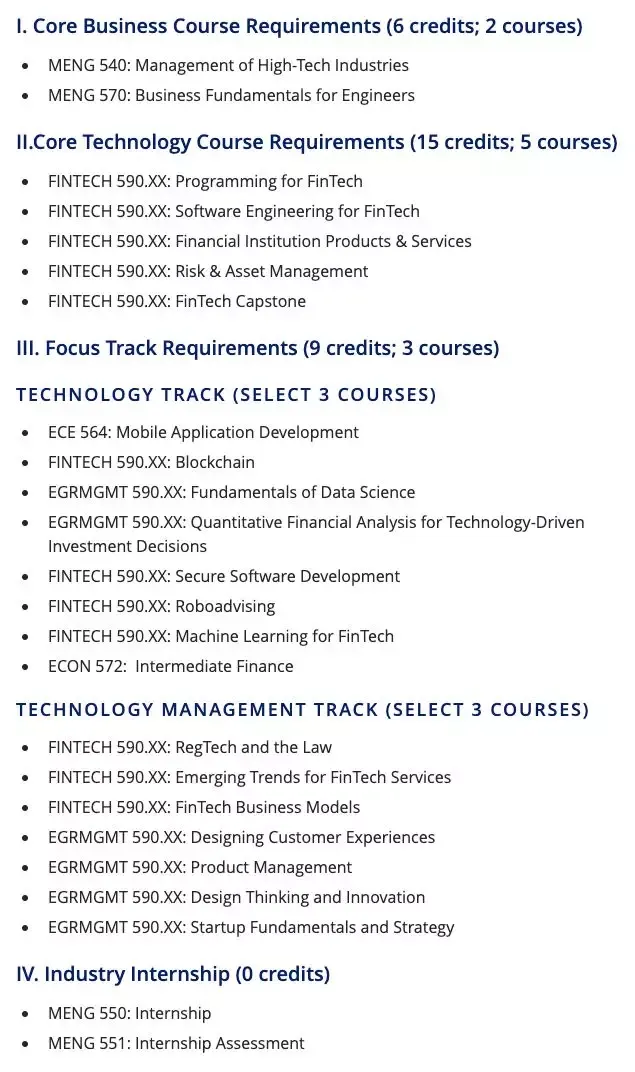
The Duke FinTech program requires the completion of 6 core courses, 1 industry internship, and 1 capstone project.
Elective courses are divided into two tracks—Technology and Technology Management—from which students must select 3 courses.
Course details are as follows:
Application Requirements:
- Applicants from various backgrounds are accepted, including engineering, computer science, physics, mathematics, statistics, econometrics, economics, and business.
- GRE and TOEFL scores are required.
Application Deadlines:
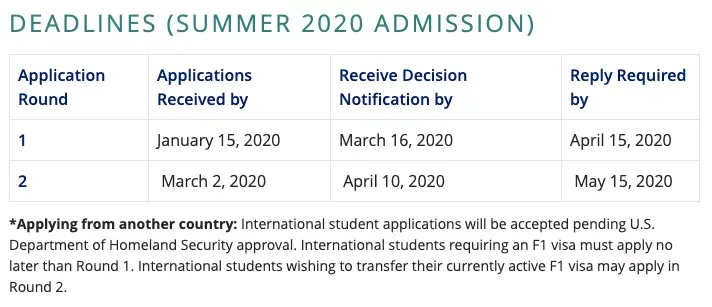
Note: International students needing an F1 visa must apply by Round 1.
What is FinTech?
Financial Technology (FinTech) is the integration of finance and technology. With the advancement of technology, emerging tools such as big data, cloud computing, artificial intelligence, and blockchain are combined with finance and applied across areas like payment and settlement, trading and investment, and financing management.
The Wharton School of the University of Pennsylvania defines FinTech as: "an economic industry composed of companies that use technology to make financial systems more efficient."
KPMG describes FinTech as: "non-traditional enterprises that use technology as a cutting-edge tool to enter the financial sector, seizing market share with more efficient technological methods, improving the efficiency of financial services, and better managing risk."
Crowdfunding platforms, blockchain and cryptocurrencies, mobile payments, insurance, stock trading apps, and budgeting apps are all real-world applications of FinTech.
One of the largest mergers and acquisitions this year was completed through FinTech, and there are now more than 20 FinTech unicorns valued at over $1 billion. According to the 2018 China FinTech Employment Report, 92% of surveyed FinTech companies believe China is currently facing a severe shortage of FinTech professionals.
Amid this rapid development, many institutions around the world have successively launched FinTech programs to cultivate more talent in the field.
Global FinTech Programs
Imperial College London: MSc in Financial Technology
The MSc in Financial Technology is a new program launched by Imperial College London in 2019. It is a one-year full-time course with tuition of £35,900, starting in August 2020.
The program equips students with quantitative analysis skills, including coding and programming, and provides hands-on experience through immersive learning.
Curriculum:
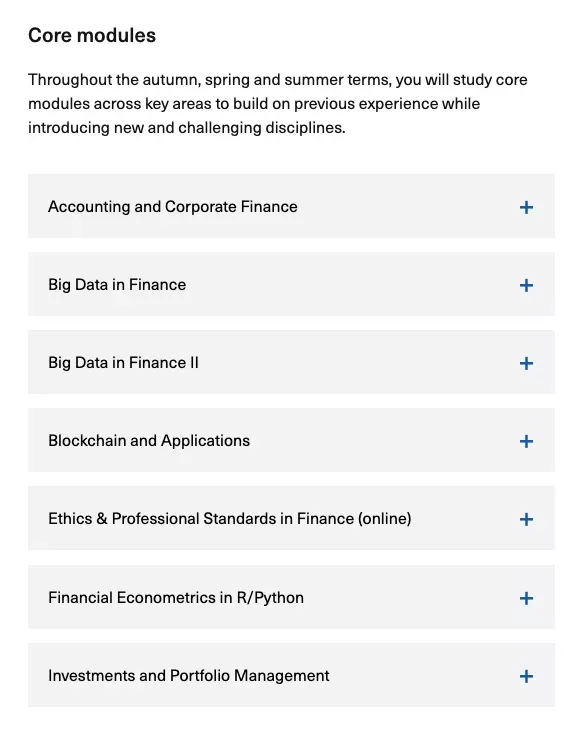
The program structure includes online pre-study modules, a foundation module, core modules, electives, and a project.
Core courses cover key areas such as accounting, systematic trading strategies, big data, financial econometrics, investment management, and empirical finance.
Core courses are as follows:
Application Requirements:
- Background in engineering, computer science, mathematics, economics, finance, physical sciences, or related fields.
- Programming experience is strongly recommended, especially for those with less technical degrees.
- Career planning questions.
- IELTS: minimum 7.0 overall, with no sub-score below 6.5 / TOEFL: minimum 100 overall, with no sub-score below 22.
- GRE or GMAT scores are recommended (GRE Quantitative score of 159+ or GMAT Quantitative score of 48+ will strengthen the application).
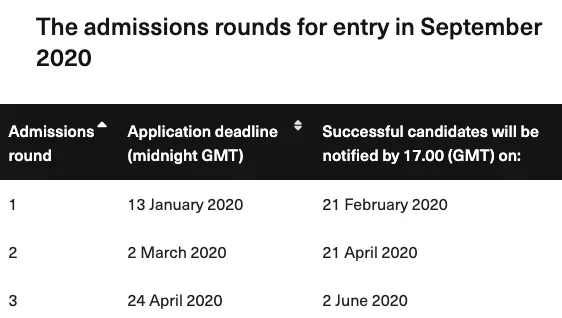
Application Deadlines:
Nanyang Technological University, Singapore: MSc in FinTech
NTU Singapore's newly launched MSc in FinTech is jointly offered by the School of Physical and Mathematical Sciences. The program is underpinned by data science, artificial intelligence, and information technology, equipping students with FinTech skills to navigate the changing financial industry landscape.
Curriculum:
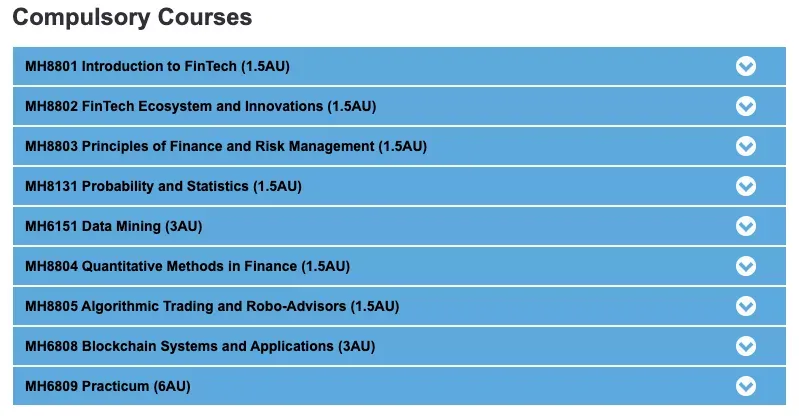
The program is available as a 1-year full-time or 2-year part-time option, totaling 33 academic units. It offers two specializations: AI and Operations and Compliance.
Core courses are as follows:
Application Requirements:
- A bachelor's degree in a quantitative or business-related field.
- TOEFL: 92+ / IELTS: 6.5+.
- Preference will be given to applicants with excellent GRE or GMAT scores.
- Preference will be given to applicants with at least 2 years of relevant work experience.
Application Period:
November 1, 2019 – January 31, 2020.
Hong Kong University of Science and Technology: MSc in Financial Technology
HKUST's MSc in Financial Technology provides students with fundamental knowledge and skills related to the burgeoning FinTech landscape and its engineering and financial principles, incorporating expertise from fields like information technology, blockchain, and decision analytics.
Curriculum:
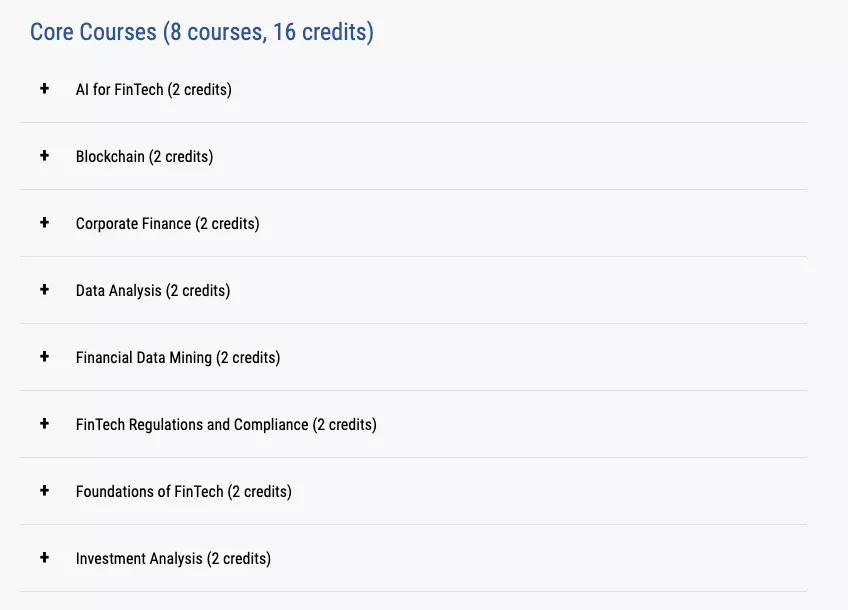
The program offers both a 1-year full-time and a 2-year part-time option, with a total of 30 credits.
Core courses are as follows:
Application Requirements:
- Applicants are recommended to have a background in mathematics and programming.
- English language proficiency scores.
- GRE/GMAT scores are strongly recommended.
- For full-time applicants, no minimum work experience is required, but relevant experience will be an advantage; for part-time applicants, a minimum of 2 years of work experience is strongly recommended.
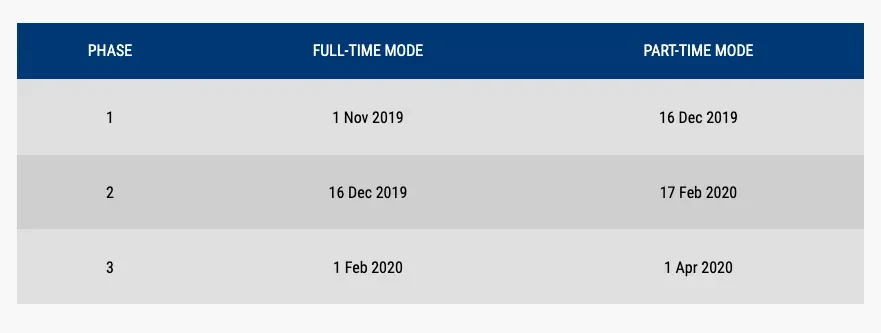
Application Deadlines:
FinTech is regarded as the next major direction of competition for financial institutions, yet there are currently only a limited number of universities offering FinTech programs, a situation reminiscent of the early days of Business Analytics.
Unlike BA programs that were first led by U.S. institutions, FinTech programs have initially gained more traction in Asia and the UK. However, with Duke's launch, it is expected that more American universities will follow suit and introduce this emerging field.
Looking at the requirements of various FinTech programs, it is evident that applicants with a science and engineering background will have an advantage. Business students with weaker technical skills may need to supplement their knowledge with relevant prerequisite courses.
As first-year cohorts may have somewhat more flexible admissions, there are also many uncertainties. CheersYou(清柚教育) advises students to make rational school selections and precise positioning based on their own profiles.
FinTech is expected to heat up rapidly in the coming years, much like BA did, leading to increasingly intense competition. Students who have the ability and interest in FinTech may consider catching this early wave.