Entrepreneurship belongs to the business category, but for international students, it may still be a bit unfamiliar compared to management, finance, marketing, and this year’s hot business analytics. In fact, entrepreneurship has been in the U.S. university major catalog since as early as 1995.
Initially, entrepreneurship was a track within the MBA program; later, with the rise of entrepreneurial waves, many schools began establishing Master’s programs.
As a cross-disciplinary field, entrepreneurship not only helps grasp first-hand industry information but also provides ample professional knowledge accumulation. After all, courage alone is far from enough for entrepreneurship—the latest information and professional knowledge are also needed.
The knowledge covered by entrepreneurship spans corporate strategy, business decision-making, product design, risk management, innovative technology, etc., emphasizing long-term social value. The major focuses on cultivating students’ business capabilities and innovative thinking, helping them demonstrate social value.
Entrepreneurship courses generally emphasize a combination of theory and practice, so graduates have more hands-on experience than other newcomers to the workplace. Meanwhile, employment prospects for entrepreneurship are quite broad; besides founding their own companies, investment banks, emerging enterprises, consulting firms, etc., can all be choices after graduation.
Below are 5 Entrepreneurship master’s programs recommended by CheersYou(清柚教育) for your reference.
1. University of Southern California - MS in Entrepreneurship and Innovation
USC MS in Entrepreneurship and Innovation
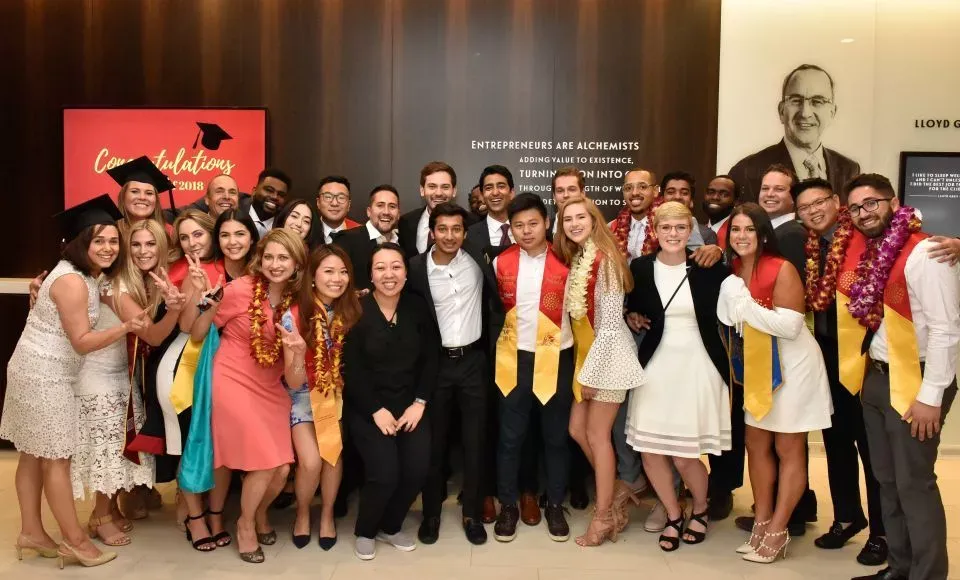
The MSEI program is housed in the Marshall School of Business, backed by the world-renowned Lloyd Greif Center, providing students with comprehensive services around entrepreneurship and innovation, including consulting, lectures, team building, mentoring, and seeking investment.
The program aims to cultivate business leaders with both entrepreneurial innovation ideas and practical abilities. The courses are flexible yet in-depth, and each is highly practical, covering feasibility analysis, startup launch, product development, and entrepreneurial management across various industries. The core course professors all have rich entrepreneurial experience and care about each student’s actual situation, offering help based on their characteristics.
The program places emphasis on the personal trait of innovative thinking; related questions are asked in interviews. Relevant course projects are also done in actual courses, and teamwork ability is highly valued.
• Accepts diverse undergraduate academic backgrounds; a business major is not required.
• The minimum TOEFL requirement is 100; no GMAT/GRE is required, but most admitted students submitted GMAT scores.
• An interview is required, conducted personally by the director or core course professors, very targeted at the personal experiences described on your resume, aiming to understand whether your true situation matches the program’s teaching philosophy.
• Work or entrepreneurial experience is not required, but the vast majority of admittees have some work experience or entrepreneurial background.
2. Brown - PRIME (Program in Innovation Management and Entrepreneurship)
Brown University PRIME (Program in Innovation Management and Entrepreneurship)

The PRIME program is housed in Brown University’s School of Engineering. Students will learn how to use emerging technology as the foundation for creating business value and new ventures.
The program will teach students how to launch and grow technology-based businesses in a fiercely competitive and rapidly developing market.
The curriculum generally consists of six core courses and two electives, covering multiple fields that combine business and engineering, including engineering management, technology management, technology commercialization decision-making, etc. Students also need to complete a technology entrepreneurship project and participate in an overseas study visit.
• Prefers applicants with STEM-related backgrounds.
• TOEFL 90 or IELTS 7.0 or above, and GRE/GMAT scores are required.
• No work or entrepreneurial experience required.
3. University of Michigan Ann Arbor - Master of Entrepreneurship
University of Michigan Ann Arbor Master of Entrepreneurship

Program Duration: 1 year Credits: 36
The University of Michigan’s Master of Entrepreneurship is a joint degree program offered by the College of Engineering and the Ross School of Business.
These two schools at the University of Michigan are ranked very highly nationwide, and their educational resources and strength can be said to represent the highest level in the United States. The value of the Master of Entrepreneurship program is self-evident.
The MSE program originated from the university’s long-term engagement with numerous technology entrepreneurs. Based on their outstanding technical levels, many entrepreneurs already have initial-stage companies but make mistakes because they have not systematically learned the fundamentals of business operations.
The skills they need cannot be learned in any discipline’s university classroom. Therefore, the University of Michigan decided to establish this program, primarily serving those who want to found their own companies in the high-tech sector, helping students integrate a vision of technological innovation with the business operation models of small and medium-sized entrepreneurial ventures.
What the program values most:
• Technology-related undergraduate background
• Future career plans (leadership positions in technology-related industries)
• Innovation and risk-taking spirit in personal experiences or ideas
• GRE/GMAT scores required
• Students will be invited for an interview
4. University of Pennsylvania - Education Entrepreneurship
University of Pennsylvania Education Entrepreneurship

The Graduate School of Education at Penn is currently ranked the second-best education school in the United States, and its Education Entrepreneurship program is very distinctive, with pioneering historical significance.
It is the world’s first graduate program combining education and business entrepreneurship management, thanks to Penn’s abundant education resources and the strong strength of the Wharton School.
The program primarily targets those who have accumulated years of experience in the education field or have entrepreneurial experience in the education industry. The 13-month program features an Executive Style: centralized classes are arranged for several days each month, and the rest of the time can be used for work or other activities. A total of 9 courses and a capstone project need to be completed.
The curriculum design, from both education and business perspectives, provides knowledge and skill training as well as overall personal quality enhancement for entrepreneurs in the education industry.
The graduate program’s curriculum is as follows: In education, it involves educational philosophy, sociology of education, the evolution and development of education, and the role of educational entrepreneurship in the entire industry landscape, leaning toward theoretical foundations; in business, courses are mainly taught by Wharton professors, covering entrepreneurship courses, educational technology, economics of education, etc. The primary goal is to cultivate students’ ability to apply technology in education, design school curricula, expand the social impact of education, and lead innovation in educational organizations and enterprises.
Background requirements for students:
1. Bachelor’s degree (no restriction on major)
2. No less than 3 years of education-related work experience
3. No minimum GPA required, and GRE scores are not required. The program mainly values relevant background and experience.
5. University of Rochester- TEAM (Technical Entrepreneurship and Management)
University of Rochester TEAM (Technical Entrepreneurship and Management)

The TEAM program is a joint offering of the Simon Business School and the Hajim School of Engineering and Applied Sciences at the University of Rochester.
The core educational philosophy of the program is to combine entrepreneurship courses with advanced technical education. It is designed for students with an undergraduate background in engineering, science, or mathematics who want to combine technology with business, corporate management, and leadership courses at the graduate level.
Students in the TEAM program are required to select a technical concentration such as optics, energy and environment, computer science, biomedical engineering, data science, materials science, chemical engineering, electrical and computer engineering, or mechanical engineering as their major focus during their studies. Students take courses in both the business school and the engineering school, and upon graduation, they will be awarded a Master of Science degree by both schools.
Courses offered by TEAM include: three business courses focused on entrepreneurship from the business school, three engineering courses from the Hajim School of Engineering and Applied Sciences, and additional technical or entrepreneurship elective courses.
• Suitable for applicants with undergraduate backgrounds in engineering, computer science, biology, chemistry, physics, or mathematics.
• Work experience is not required for this program.
• GRE or GMAT scores are not required but recommended.
Although entrepreneurship is a relatively niche business program, for students interested in entrepreneurship, it can also be an application choice to avoid the highly popular business programs.
If you want to learn more or have other study abroad application questions, feel free to consult a CheersYou(清柚教育) advisor!