The impression many have of the UK is mainly that of a quirky nation, afternoon tea, and the ability to apply to universities casually without GRE/GMAT.
Right now, many juniors and seniors are still battling the GRE, tormented by the exam. Naturally, some students, in hopes of escaping the clutches of GRE/GMAT, are flocking to study in the UK.
But here's the question: are UK schools still that easy to apply to? Can you definitely secure a UK offer without the G?

G5 Universities' Application Requirements
The G5 has always been the dream UK destination for all students, and the admission standards of these top institutions are naturally very high.
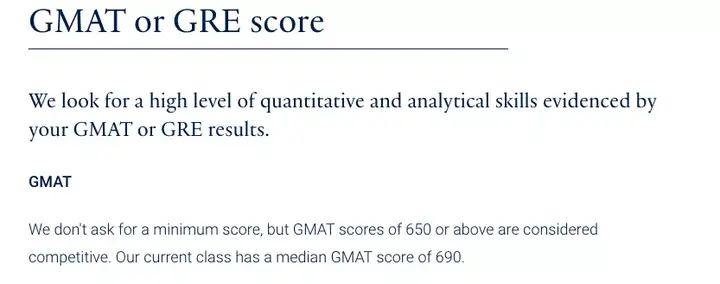
First of all, their MBA programs all require GMAT or GRE scores. If you want to pursue an MBA, you still cannot escape standardized testing.
Oxford MBA requires GMAT/GRE scores:
Now let's look at other programs:
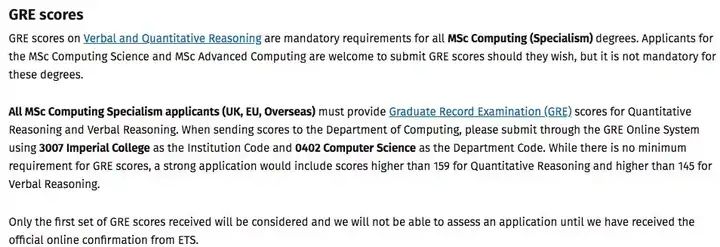
All degree programs under Imperial College London's MSc Computing require the GRE, submitted at the time of application, and only the first submitted score is considered.
Imperial also states that Verbal 145+ and Quant 159+ are considered competitive scores.
CheersYou(清柚教育) has also compiled a list of some G5 programs that require G exam scores:
University of Oxford:
MSc in Economics for Development, MSc Financial Economics, MPhil in Economics, etc.
University of Cambridge:
MPhil in Economics, etc.
London School of Economics and Political Science (LSE):
MSc in Accounting and Finance, MSc in Economics, MSc in Economics and Management, MSc in Finance, MSc in Marketing, MSc in Management, etc.
University College London (UCL):
Economics MSc, etc.
Imperial College London:
MSc in Computing (Specialism), etc.
This shows that popular G5 programs in business, management, and some STEM fields all require GRE/GMAT scores, and many programs strongly recommend submitting them.
Application Requirements at Other Top UK Universities
Now let's look at the attitude of other top UK universities besides the G5 towards G exam scores.
The University of Edinburgh, a world top-20 institution, is also a dream destination for many. For some programs, mainly in economics, Edinburgh recommends submitting GRE/GMAT scores.
MSc Economics
MSc Economics (Econometrics)
MSc Economics (Finance)
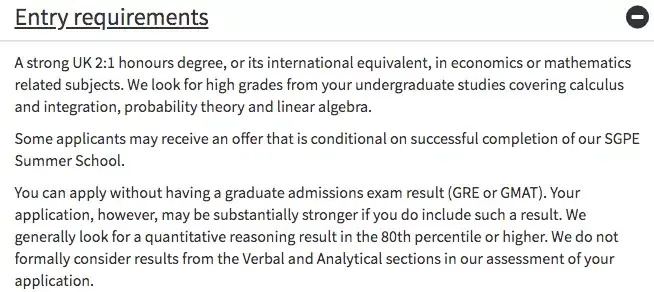
The official website says: GRE/GMAT scores are not mandatory, but submitting them will strengthen your application, and it is considered that a math score percentile rank above 80% is desirable.
Programs at other universities also strongly recommend submitting GRE/GMAT scores, for example:
The University of Manchester:
MSc Accounting, MSc Accounting and Finance, MSc Quantitative Finance, MSc Finance, etc.
University of Warwick:
MSc Management, MSc Accounting & Finance, MSc Finance, MSc Business Analytics, etc.
City, University of London:
MSc Finance, MSc International Business, MSc Management, MSc Business Analytics, etc.
Although not mandatory, many top schools use the phrase "strongly recommended," indicating that an increasing number of UK universities are placing importance on G exam scores.
Among applicants with similar backgrounds, having a good GRE score can provide a greater competitive edge. After all, the number of UK applicants is surging, and the bars at universities are rising accordingly.
Is Applying to No-G Programs Easier?
Under the circumstance where GRE/GMAT scores are not required, is the application for such programs simple?
Let's look at the application requirements for Imperial College London's MSc Risk Management & Financial Engineering program:
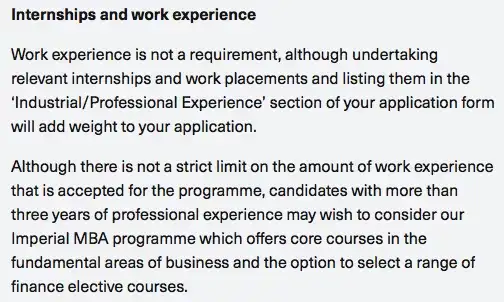
Although the program does not have a mandatory work experience requirement, having relevant internship and work experience will add weight to your application materials and improve competitiveness.
No GRE/GMAT does not mean UK applications are a breeze. Many UK universities will place more emphasis on assessing other aspects of an applicant's background, such as basic GPA, relevant work experience, and application essays.
The 2020 UK application season has been dubbed the "toughest ever." This year's application volume and competitive pressure are unprecedentedly high, and the future situation will only become more intense.
Students applying to UK universities must not let their guard down on preparing application materials and enhancing their background simply because the G exam is not required.

Plan Your Study Abroad Application Wisely
It must be said that the GRE/GMAT is indeed a test that requires time and effort. Many students face situations where, despite spending a lot of time, their scores do not improve. For example, juniors and seniors from US undergraduate programs are even more anxious due to heavy coursework.
However, do not blindly change your study-abroad direction just to escape the exam. After all, the purpose of applying to graduate school is to enhance knowledge in your field, and standardized tests like GRE/GMAT are designed to help us better adapt to the curriculum later on.

Finally, our advice is: try to achieve a good GRE/GMAT score as early as possible. A decent score means more program options, whether you plan to apply to universities in the UK or the US.
If you genuinely cannot get a satisfactory score, do more research and consult relevant professionals to plan your study-abroad application rationally. Choose a study destination and graduate program that truly suits you, and never settle for second best.
For more questions about study abroad applications, please consult CheersYou(清柚教育) Bro (WeChat: qingyouge23).
Visit the CheersYou(清柚教育) official website: CheersYou(清柚教育) [Official Website] -Cheersyou- Study Abroad Application, Essay Editing, CheersYou(清柚教育) Study Abroad
For more study abroad information, follow the "CheersYou(清柚教育)" official account.