Just today, QS released its 2020 US university rankings. This is also the first time QS has released a ranking for US universities.
Scoring Criteria
This ranking is based on the following 4 major indicators:
Employability - 27%
Diversity and Internationalization - 25%
Learning Experience - 22%
Research Strength - 26%
A total of 17 new indicators were subdivided to evaluate US universities and liberal arts colleges. The ranking involves representatives from 49 US states and over 300 institutions.
Ranking Overview
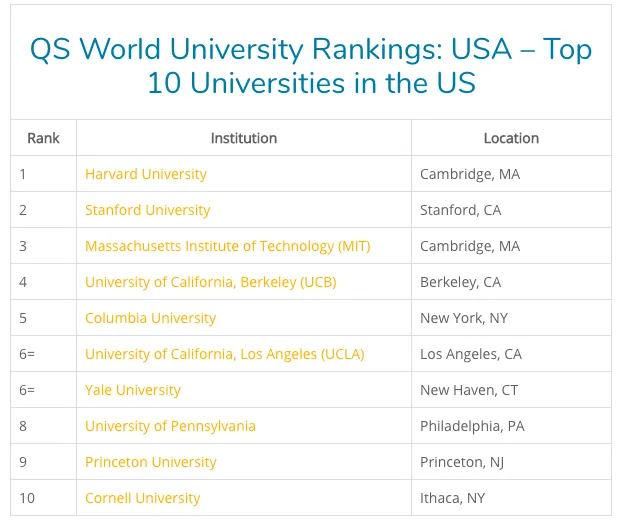
In the QS US university rankings, Harvard University ranks first in the nation, Stanford University second, and MIT third.
Within the Top 10, UC Berkeley and UCLA emerged as strong contenders, largely thanks to their high rankings in research credentials and diversity and internationalization.
UC Berkeley and UCLA ranked 3rd and 5th nationally in research respectively; UCLA's international student-to-total student ratio of 6,992/44,288 also earned it the title of the most diverse and international university in the US.
Cornell University also squeezed into the 10th spot in the QS US university rankings thanks to high research ability and employability.
In the Top 50, NYU's No. 11 ranking is eye-catching, outperforming the University of Chicago, Duke University, and Johns Hopkins University.
Boston University, University of Washington, UC San Diego, UC Davis, and other prestigious US universities also made it into the Top 30 in the QS US university rankings.
Below is the complete Top 50 list.
Complete Top 50 List
.png?x-oss-process=style/opt-webp)
.png?x-oss-process=style/opt-webp)
This is QS's first US university ranking, and its different scoring criteria make this list distinct from other rankings.
For example, the employer reputation indicator in the QS ranking is based on the views of over 44,000 hiring managers worldwide, and the employability indicator holds the greatest weight in this ranking. For students who are more concerned about future career development, this QS ranking may offer greater reference value.
Finally, rankings are still only for reference. Rankings should not be used as the sole basis for university applications. When applying to universities, everyone should consider various factors comprehensively based on their own circumstances to make more rational and personalized choices.
Source: QS World University Rankings