As the study abroad application season arrives each year, no matter which country or region your target school is in, choosing the most suitable university is one of the most pressing concerns for all applicants.
In the process of selecting schools, many students and parents naturally turn to university rankings first. However, global university rankings can be overwhelming, each with different focuses.
How to properly use rankings and maximize their reference value to help with effective school selection and positioning is a significant skill in itself.
Today, CheersYou(清柚教育) brings you an updated interpretation of the scoring criteria and reference value of major global rankings, solving all your doubts in one go!
Three Major U.S. University Rankings
U.S. News Best Colleges Rankings

The U.S. News rankings are American college rankings published by U.S. News & World Report. They cover undergraduate education, graduate education, national university rankings, and liberal arts college rankings.
U.S. News Best Colleges Ranking Indicators
Graduation and retention rates: 22%
Expert opinion: 20%
Faculty resources: 20%
Student selectivity: 10%
Financial resources: 10%
Graduation rate performance: 8%
Social mobility: 5%
Alumni giving rate: 5%
Reference Value
U.S. News rankings take into account multiple factors including acceptance rate, student-faculty ratio, standardized test scores, research output, employment outcomes, and more. The U.S. News ranking indicators are fair and authoritative, making it the most valued and referenced list by students and parents.
QS USA University Rankings

QS launched its USA university rankings for the first time this year, with a focus that differs significantly from U.S. News.
QS USA University Ranking Indicators
Employability – 27%
Diversity & Internationalization – 25%
Learning Experience – 22%
Research – 26%
Reference Value
The employability indicator carries the greatest weight in the QS USA Rankings. For students who are more focused on future career development, this QS ranking may offer greater reference value.
Niche Best Colleges Rankings

The Niche rankings are uniquely distinctive, emphasizing indicators like academics, diversity, affordability, and student satisfaction during the university ranking process.
Niche Best Colleges Ranking Indicators
Academics: 40%
Value: 27.5%
Professors: 7.5%
Campus: 5%
Diversity: 5%
Student Life: 5%
Student Surveys: 5%
Local Area: 2.5%
Safety: 2.5%
Reference Value
The greatest advantage of Niche rankings is that you can see students' comprehensive evaluations of schools. Niche's U.S. college rankings are also jokingly called "the Yelp of U.S. colleges" by netizens in China.
According to unofficial statistics, there are already over 100 million student and parent reviews of schools on the official website. Niche's ranking information is more suitable for applicants who are not familiar with the schools and want to reference student opinions and evaluations.
Three Major UK University Rankings
CUG University Rankings

CUG, short for Complete University Guide, is compiled with participation from the well-known British newspaper The Independent and is one of three authoritative UK domestic rankings.
CUG University Ranking Indicators
- Entry Standards
- Student Satisfaction
- Research Quality
- Research Intensity
- Graduate Prospects
- Student-Staff Ratio
- Academic Services Spend
- Facilities Spend
- Degree Completion
- Continuation
Reference Value
The CUG rankings are relatively comprehensive. They establish more detailed criteria to measure the academic strength and investment of schools, placing more emphasis on directly examining the school's own capabilities for ranking.
The Times and Sunday Times Good University Guide

The Times was the first among UK media to publish domestic university rankings, and its Good University Guide has significant influence in the UK.
The Times University Ranking Indicators
Student Satisfaction
Research Quality
Entry Standards
Graduate Prospects
Firsts and 2:1s
Completion Rate
Student-Staff Ratio
Services and Facilities Spend
Reference Value
The Times university rankings are also relatively comprehensive. Their indicators are similar to CUG, and the results do not differ much. However, the Times rankings require a paid subscription to access, and the website is not very user-friendly.
The Guardian University Guide

The Guardian is a well-known British comprehensive daily newspaper. The Guardian's university rankings are highly subjective and are more focused on the student educational experience.
The Guardian University Ranking Indicators
- Course Satisfaction
- Teaching Satisfaction
- Feedback Satisfaction
- Student-Staff Ratio
- Spend per Student
- Average Entry Tariff
- Value Added Score
- Career after 6 months
- Continuation
Reference Value
The highlight of The Guardian rankings is the relatively high weight given to student surveys. This tendency often leads to significant differences in their rankings compared to other institutions.
Three Major World University Rankings
THE World University Rankings
Times Higher Education World University Rankings, abbreviated as THE World Rankings, is one of the three globally recognized university rankings.
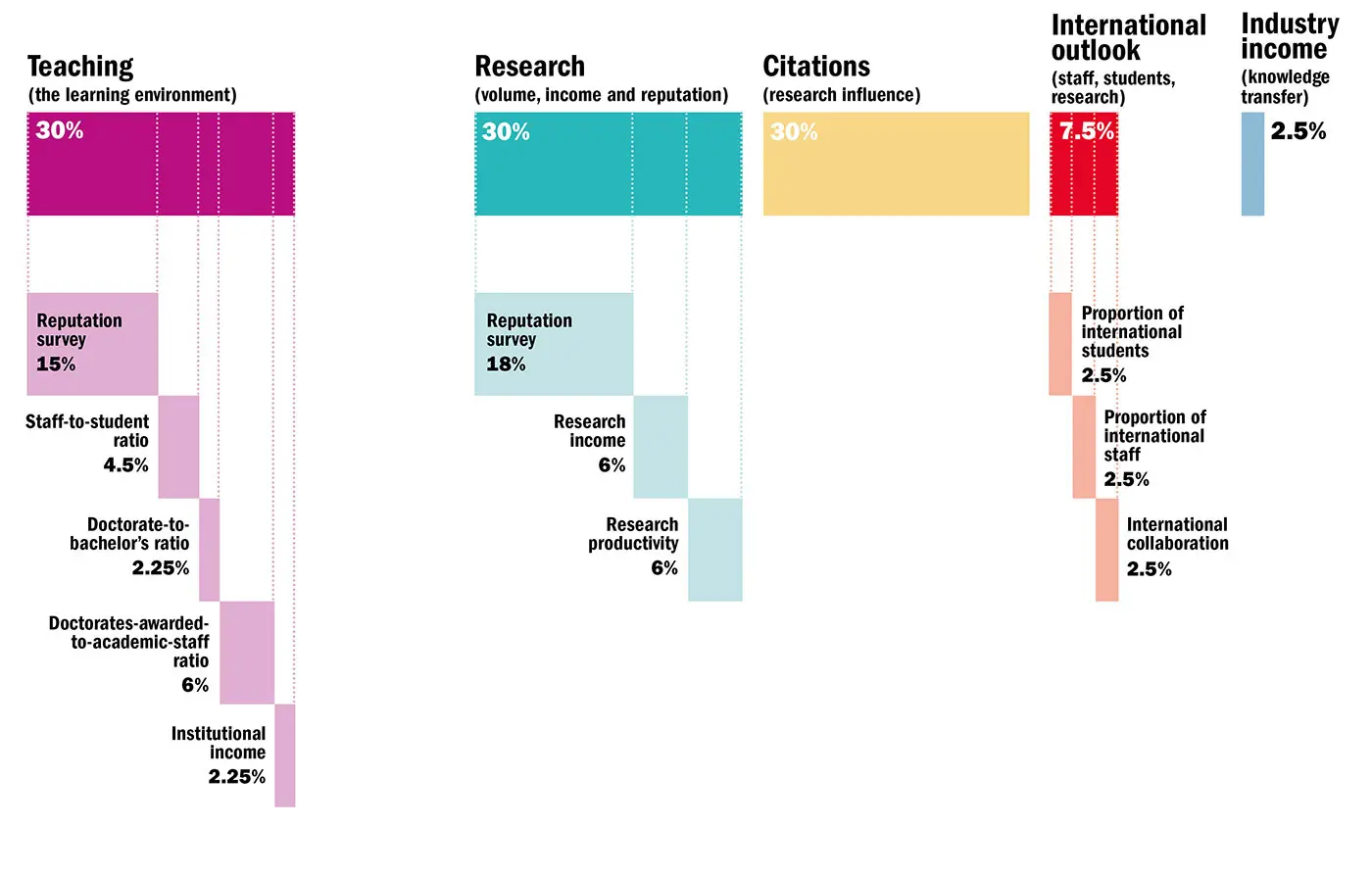
THE World University Ranking Indicators
Reference Value
THE rankings place greater weight on academic aspects, evaluating institutions across dimensions like teaching, research, citations, and industry income. They are more applicable for students who value a strong academic atmosphere.
QS World University Rankings

As one of the three major authoritative rankings, QS World University Rankings is published by the British organization Quacquarelli Symonds, which specializes in higher education and graduate recruitment information. The first ranking table was published in 2004.
QS World University Ranking Indicators
Academic Reputation 40%
Employer Reputation 10%
Faculty/Student Ratio 20%
Citations per Faculty 20%
International Faculty Ratio 5%
International Student Ratio 5%
Reference Value
Since the highly subjective "reputation" factor accounts for 50% of the weight, and some professors at top universities are too busy to fill out surveys, QS has been criticized for being "not objective enough" or having "insufficient sample size." However, overall, QS rankings can basically reflect the actual situation, and the ranking results are relatively close to what most people commonly regard as good schools.
ARWU World University Rankings

The Academic Ranking of World Universities (ARWU) was first published in 2003 by the Center for World-Class Universities at the Graduate School of Education (formerly the Institute of Higher Education) of Shanghai Jiao Tong University, China. It is a national research project and also the earliest comprehensive global university ranking.
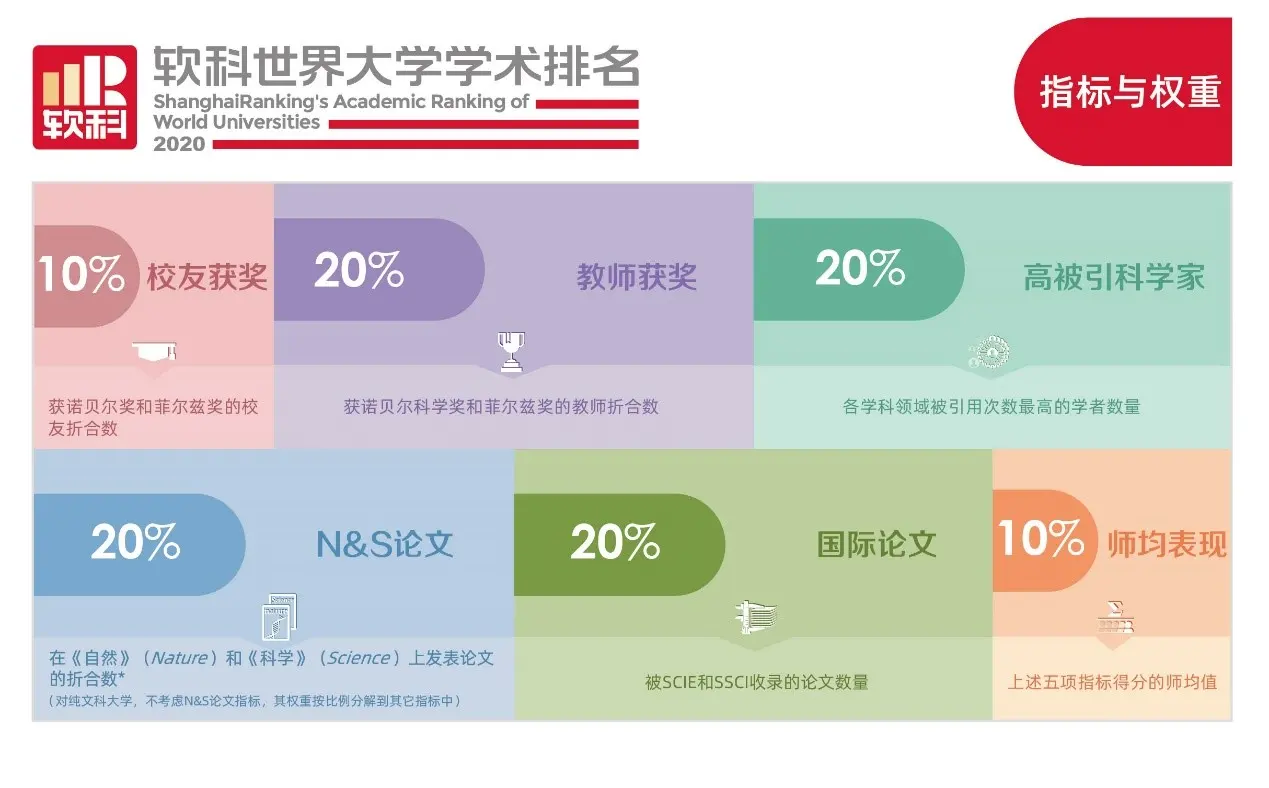
ARWU World University Ranking Indicators
Reference Value
ARWU's rankings have always been based on academics, with almost all indicators being quantitative. However, as a ranking that focuses everywhere on research achievements, ARWU has also been criticized for overemphasizing STEM fields.
Overall, ARWU is very relevant for STEM applicants, but it is less meaningful for humanities and social sciences students.
It can be seen that when major ranking organizations rank universities, they all include indicators that most people care about for evaluation. However, in terms of data sources, specific sub-indicators, score weightings, and other specific content, they employ different methods, which gives each ranking different reference values.
Rankings are still for reference only. Rankings themselves should not be used as the sole basis for university applications. When choosing target universities, everyone should view various rankings rationally and factor in their own needs to ultimately make more reasonable and personalized choices.
Accurate positioning, conquering top schools!
Scan the QR code below now to start a one-on-one study abroad consultation~
.jpg?x-oss-process=style/opt-webp)