Not long ago, a top MBA degree from Harvard or Stanford was practically synonymous with high pay, prestigious companies, and a bright future.
But recently, a piece of news has stirred up the application community: current students at Stanford Graduate School of Business (GSB) are collectively complaining that the curriculum is "out of touch with the times" and "outdated," even bluntly stating that they "can't learn anything."
Source: Poets and Quants
At the same time, MBA application numbers have surged repeatedly, yet employment data has declined year after year. Even graduates from a "hallowed degree" like Harvard are frequently stumbling in the job market.
Source: Entrepreneur
Under the multiple shocks of the rise of AI, high inflation, layoffs at big tech firms, and industry restructuring... the "gold-plating" effect of an MBA is rapidly fading.
Is Stanford's MBA Falling Behind the Times?
In interviews, current MBA students at Stanford GSB pointed out that many courses have not adapted to changes in the business environment.
Topics like AI tools, automation, and big data are touched upon, but often remain at the level of "theory plus cases," lacking hands-on practice or genuine training in future-ready skills. Some professors are actively embracing new trends, but others are slow or even resistant to updating content.
Source: Poets and Quants
Moreover, the school's curriculum structure is riddled with problems: electives are disconnected from core courses, popular courses require a lottery system; some required courses repeat content without adding anything new; and the school seems somewhat underprepared for disruptive trends like digitalization and AI.
Source: Poets and Quants
One student bluntly stated: "The school simply doesn't prioritize teaching; the administration's vision is miles apart from students' expectations."
This is not just simple grumbling, but a deep anxiety among elite MBA students that their future competitiveness is being undermined.
The Bitter Job Market for Elite MBAs
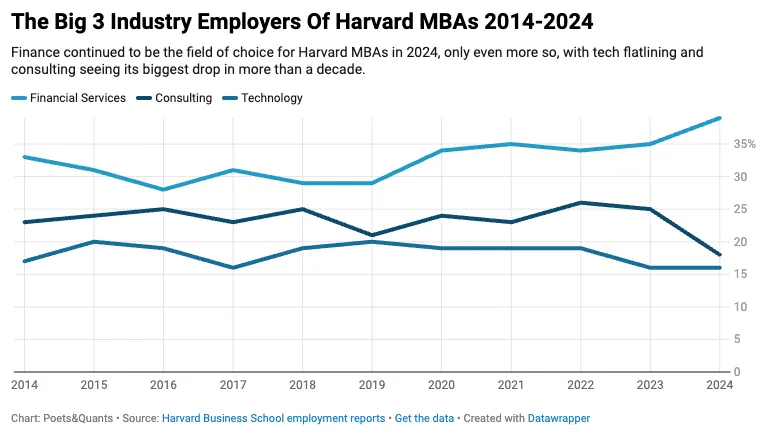
According to Entrepreneur, even at top business schools like Harvard, Stanford, and Wharton, an increasing number of graduates are still unable to find ideal jobs three months after obtaining their degree.
Source: Entrepreneur
Among Harvard MBA graduates, 23% of job seekers were still unemployed after three months. This is a significant increase from the roughly 10% in 2022.
Source: WSJ
Hiring in consulting and finance has sharply contracted, and tech giants like Amazon, Google, and Microsoft have also reduced MBA campus recruitment. Companies now care more about whether candidates can solve problems on the ground and use AI tools, rather than just a prestigious diploma.
Interestingly, the colder the job market, the hotter MBA application interest becomes.
The Financial Times reports that over the past year, top business schools like Booth and the M7 have seen double-digit growth in applications.
Many people treat an MBA as a "safe-haven investment": even if they may not find a job immediately after graduation, they can at least temporarily avoid the fiercely competitive market.
Source: FT
The contradiction, however, lies in the fact that while application numbers are skyrocketing, employment prospects are continually tightening.
MBA graduates' salaries may appear stable in statistics, but the real question is: how long does it take to find a job, and what is the quality of the offer?
Another force disrupting the MBA halo is artificial intelligence.
On one hand, the rapid development of AI is swiftly devaluing MBA graduates' skills: financial modeling, market analysis, business plans—these traditional MBA strengths can be done by AI tools in seconds.
On the other hand, business school curricula are slow to update. Students complain that AI is merely "touched upon" in class, never becoming a core training focus.
Additionally, the logic of corporate hiring is changing. More and more companies value "tool proficiency + practical experience" over simply chasing "prestigious school + degree."
Source: The Economist
MBA Is No Longer a "Golden Ticket"
The MBA was once a "golden ticket" for the elite, but under the dual impact of AI disruption and a cooling job market, that ticket is fading.
More and more evidence shows that today's severe employment problems cannot be easily solved by simply returning to campus for an MBA to burnish your credentials.
When choosing an MBA program today, one must be more rational and examine:
-
Whether the curriculum is updated in a timely manner and aligned with current industry developments
-
Whether alumni and industry networks are active, and whether employment reports are transparent
-
Look not only at starting salaries, but also at the employment rate and job quality at 3 months and 6 months after graduation
Blindly chasing popular majors that were once considered "guaranteed employment"—whether MBA or CS—has passed its prime. Rather than fantasizing that a single diploma can cure all ills, it is wiser to calmly analyze industry trends, choose a direction rationally, and pursue effective self-improvement.
Future competition will not be a simple battle of brand prestige, but about who can identify the right specialization and truly apply what they learn, combining new skills, practical ability, and the capacity for continuous evolution.