
As artificial intelligence continues to be integrated into engineering practice, the University of Michigan College of Engineering has announced the launch of a new graduate program in AI+Engineering. This program combines artificial intelligence with specific engineering disciplines, helping students master both AI technologies and domain-specific knowledge.
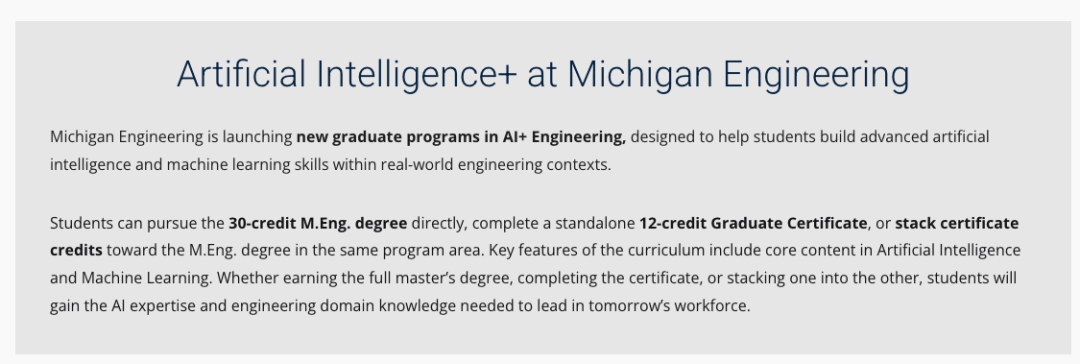
The on-campus master's program is scheduled to launch in Fall 2027, with online offerings launching concurrently or shortly thereafter. The series includes a 30-credit Master of Engineering degree and a 12-credit graduate certificate program.
Source: umich
University of Michigan Launches New AI Engineering Master's Program
Program Overview
The official degree name for the new master's program is the Master of Engineering in Artificial Intelligence Engineering (MEng), which offers seven engineering specialization tracks.
Students' transcripts and diplomas will indicate the Master of Engineering in Artificial Intelligence degree along with their chosen engineering specialization track.
The program emphasizes the integration of AI technology with engineering domain knowledge, cultivating students' ability to develop, adapt, and apply AI tools within complex engineering systems.
Source: umich
Specialization Tracks
The on-campus master's program launching in Fall 2027 covers the following seven tracks:
-
Aerospace Engineering
-
Biomedical Engineering
-
Civil & Environmental Engineering
-
Electrical and Computer Engineering
-
Industrial and Operations Engineering
-
Mechanical Engineering
-
Nuclear and Radiological Sciences
Curriculum Structure
The master's program requires the completion of 30 credits, divided into three components:
AI and Machine Learning Foundations: 12 Credits
Study the fundamentals and techniques of artificial intelligence and machine learning.
Domain-Specific Interdisciplinary Courses: 12 Credits
Combine your chosen engineering track with courses that explore the application of AI and machine learning in specific professional domains.
Knowledge Expansion Courses: 6 Credits
Deepen or broaden your knowledge through elective expansion courses. The Industrial and Operations Engineering track follows this same credit structure.
Specific courses vary by specialization track. For example, in the Industrial and Operations Engineering (IOE) track, students build a foundation in optimization, statistics, and analysis, while learning to apply AI methods to areas such as business operations, healthcare engineering, human-machine system integration, and financial engineering.
Source: umich
IOE course options include:
-
Continuous Optimization Methods
-
Reinforcement Learning
-
Data and Decision Analytics
-
Optimization Methods in Supply Chain Management
-
Machine Learning for Infrastructure Systems
-
Ethics for AI and Robotics
Application Requirements
Since the Master of Science in AI Engineering offers multiple specializations, specific application requirements should be referenced from the corresponding department.
Taking the Biomedical Engineering (BME) specialization as an example:
Academic Requirements
-
Possess a bachelor's degree in engineering or physical sciences; the university also considers applicants from closely related disciplines, particularly those with a quantitative life sciences background.
-
Minimum undergraduate GPA of 3.2/4.0.
-
Completion of biology or physiology courses with laboratory components.
-
Completion of two semesters of physics.
-
Foundational knowledge in mathematics, including linear algebra, ordinary differential equations, and statistics.
-
Completion of at least four engineering courses.
Source: umich
The university evaluates applicants based on their background and academic preparation. Students who do not meet the relevant requirements must complete necessary prerequisite courses, which will not count toward graduate credits for the degree or certificate.
Application Materials
-
Undergraduate transcripts.
-
Curriculum Vitae (CV)/Resume.
-
Statement of Purpose: Include research interests; recommended length is no more than two pages.
-
Personal Statement: Describe personal experiences, background, and motivation for pursuing a degree in Biomedical Engineering.
-
Three letters of recommendation.
-
Proof of English language proficiency (for non-native English speakers).
-
GRE scores are not required for this specialization.
Application Timeline
January 15, 2027: Application Deadline
From AI fundamentals to specialized applications, the University of Michigan’s new AI + Engineering program integrates AI training with multiple engineering disciplines.
Students planning to apply for Fall 2027 are encouraged to contact CheersYou (清柚教育) based on their professional background to learn more about relevant coursework and application details.