Amid the ongoing trade war between China and the US, the RMB exchange rate breaking 6.91, and tightening visa restrictions for STEM students, many prospective students and their parents have been gripped by panic.
With the future still uncertain, many are asking: Should I still go to the US, or consider other countries or regions for study?
To address such concerns, CheersYou(清柚教育) has compiled a comparative analysis of study destinations—the US, UK, Canada, and Hong Kong—to help you better weigh the pros and cons of applying and choose the plan that suits you best.
Study Destination Comparison
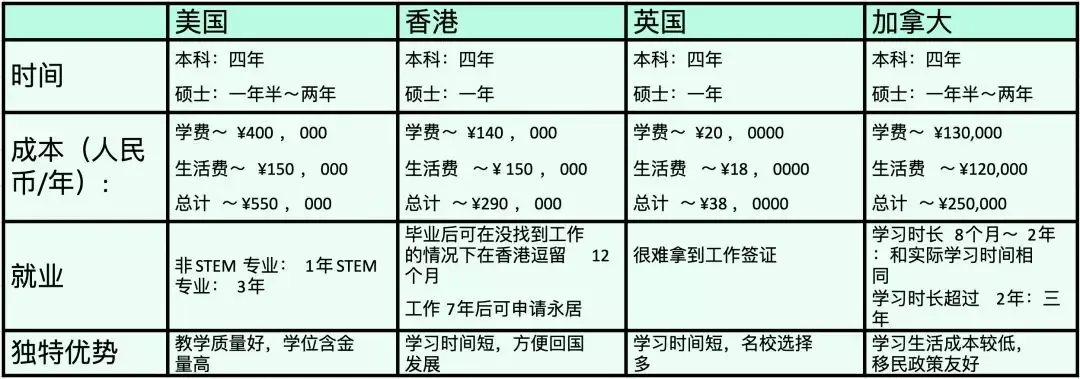
Overall, despite the heated trade war, many students still choose to study in the US. The fundamental reason lies in the gap in educational competitiveness between China and the US.
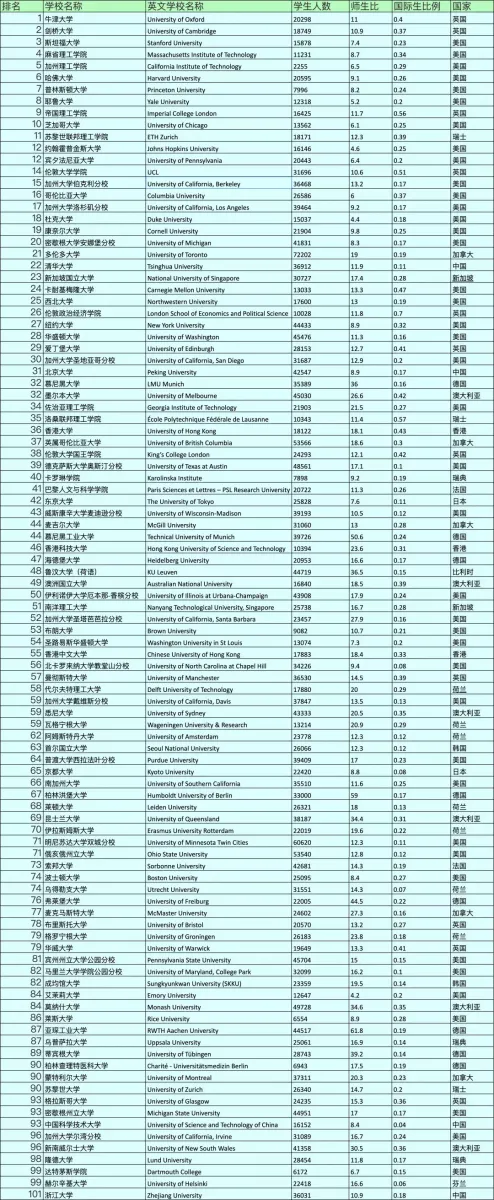
In 2018, Times Higher Education released its 14th annual World University Rankings. Globally, nearly half of the top 100 schools are in the US, while China has only five. The number of top US universities is eight times that of China's.
Application Difficulty
United States
Generally speaking, applying for a US master's degree requires the most materials and the most complex process.
Academic Requirements: A GPA of 3.0 is recommended, equivalent to an average score of 80% or above.
Language Requirements: Top-ranked schools generally require a TOEFL score of 100 or above; slightly lower-ranked schools still require 90+. Although most US universities also accept IELTS, the score advantage is less obvious.
Personal Statement & Essays: The scope for creativity is huge—this is what admissions officers value most, and what gives countless students the biggest headache. Content includes your views on the major, your academic experience and past projects, motivation for applying, and more. Some schools even specify additional academic essays (e.g., Johns Hopkins requires two essays). Whether a student from a non-prestigious university gets in or a top student fails often comes down to the quality of the essays.
Letters of Recommendation: Each school generally requires 2–3 recommendation letters.
GMAT/GRE: Business master's programs require GMAT; other fields require GRE. Now many business programs also accept GRE. While most schools don't list specific cut-off scores, top schools prefer GRE 320+ or GMAT 700+.
United Kingdom
The UK is relatively more straightforward—mostly looking at grades and language scores, plus recommendations. The UK G5 universities place extra emphasis on academic background.
Academic Requirements: As school rankings drop, academic requirements also decrease. Top 50 schools require an average of 80%+; Top 100: 70%–75%; Top 500: 65%–70%.
Language Scores: Top 50 schools require IELTS 7; most others require 6.5, with sub-scores around 6.
GMAT/GRE: For G5 universities, GMAT 700+ or GRE 320+ is recommended.
Canada
Academic scores, language scores, recommendation letters, and essays are required; a few require GMAT/GRE. The application process is also quite challenging.
Academic Scores: Canada sets a high bar—generally an average of 80%+. Since many programs don't mandate GMAT/GRE, GPA is weighted even more heavily.
Language Scores: Top schools require IELTS 7.0; typical schools require 6.5.
Hong Kong
For HKU, HKUST, and CUHK, academic requirements are high, and both essays and recommendation letters are needed.
Academic Scores: These three schools require an average of 80%+.
Language Scores: IELTS 7.0+ is recommended.
GRE/GMAT: No hard requirement, but schools strongly encourage submission.
Recommendation Letters: Generally at least three letters required; some schools require internship recommendation letters.
Still unsure about study destinations or how to choose a major? Check out: 18-19 Annual College Salary Report: Which Majors Earn the Most?