
1. What is Business Analytics?
Business Analytics aims to turn big data into actionable strategic decisions. To do this, business analysts use various statistical quantitative methods, computational tools, and predictive models, drawing on their knowledge of finance, corporate management, and economics to make data-driven decisions.
Unlike Business Intelligence (BI), which leans more toward measuring past performance and summaries, Business Analytics (BA) focuses more on prescriptive and predictive techniques (e.g., "What should we do?" and "What will happen next?").
Business Analytics also differs from Data Science. BA curricula are usually more focused on mining data to achieve specific business objectives, such as increased profits.
2. Is Business Analytics still hot this year?
Relevant reports indicate that the Business Analytics market is expected to see a compound annual growth rate of around 7.3% from 2019 to 2023.
End-user groups continue to expand, and data from user devices has grown substantially; consumer purchasing power keeps rising, with related data trends continuously updating.
The amount of data businesses need to handle is only increasing, requiring more BA talent to help companies understand user behavior and formulate more effective competitive strategies.
Applications for BA programs at U.S. universities continue to surge: programs are few, but applicants are many. It is not uncommon for over a thousand people to compete for a BA program with fewer than 100 spots.
The industry is developing rapidly and its prospects are enticing. It can be said that BA remains as popular as ever, and application requirements are continuously rising.
3. What are the application standards?
As a relatively new field, BA has no uniform application requirements across different universities and schools.
Most BA master's programs hope applicants have a matching undergraduate background, and enrollment ratios in this regard vary.
MIT's BA program primarily admitted students from mathematics, physics, and engineering backgrounds in its early years; the latest class profile shows some diversification.
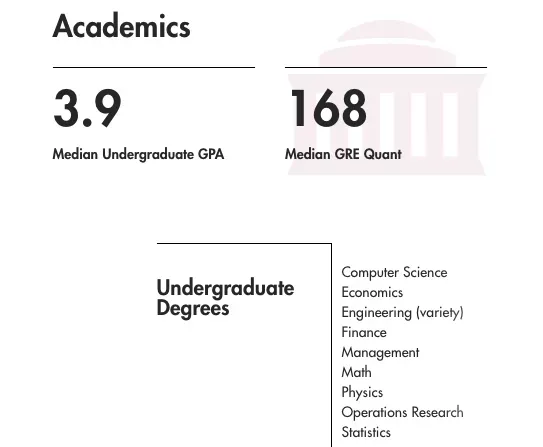
*Undergraduate backgrounds of MIT BA program
UT-Austin's BA program mainly admits students with engineering and business backgrounds.
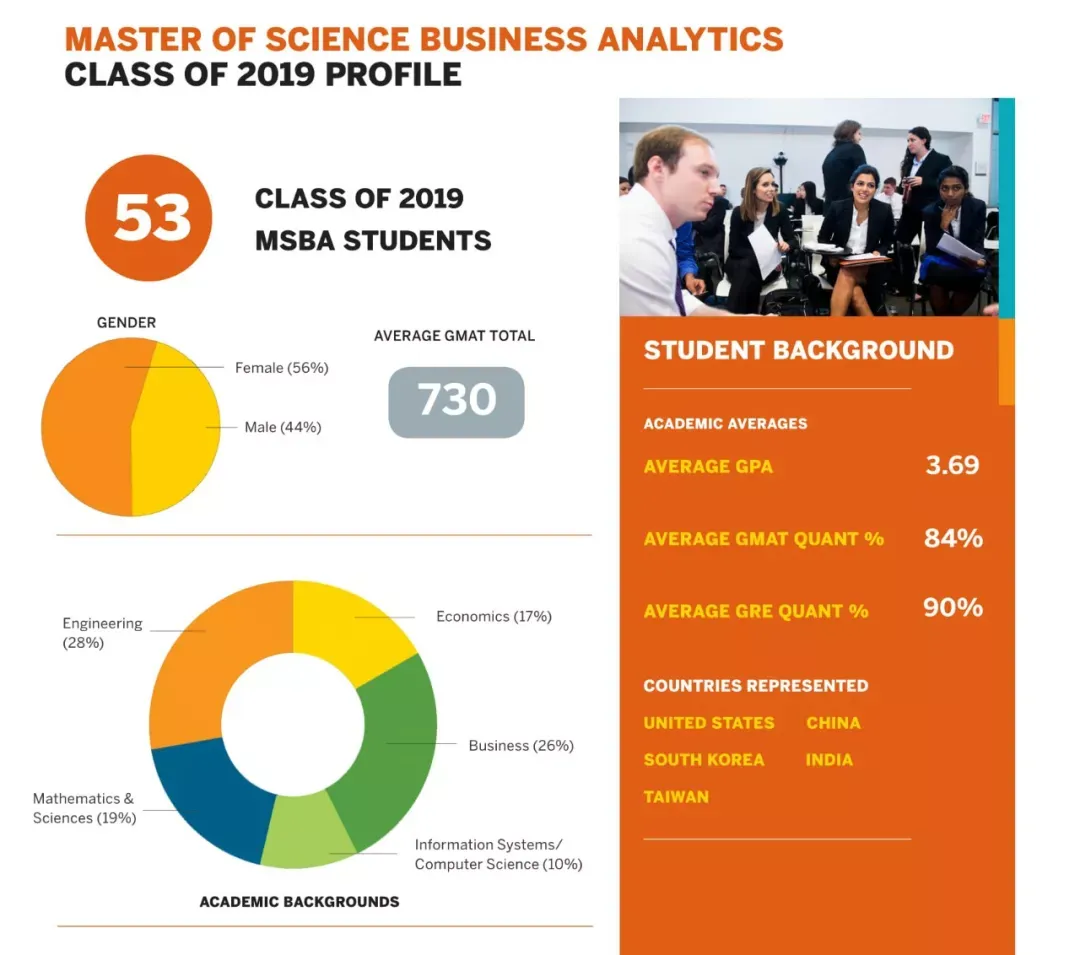
*Undergraduate backgrounds of UT-Austin BA program
University of Rochester's BA program students predominantly have business backgrounds.
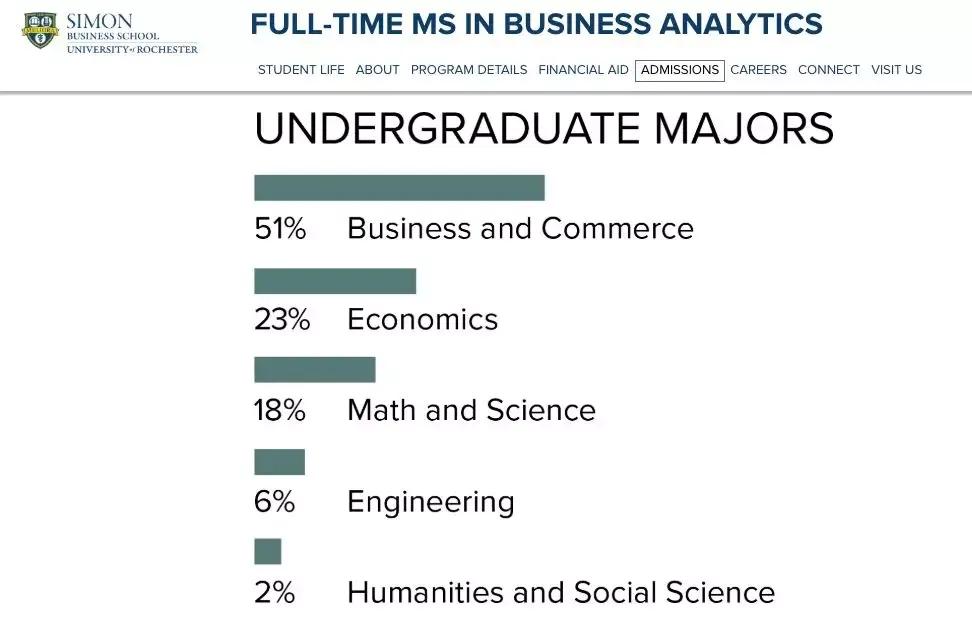
*Undergraduate backgrounds of University of Rochester BA program
BA-related programs under different schools can also have varying admission standards.
For example, Columbia offers two analytics-related programs: Business Analytics and Applied Analytics, with significant differences in curriculum. The BA program housed in the Engineering School and Business School has very high requirements and a more technical focus, while the AA program under the SPS School leans toward practical application and does not have high programming background requirements.
Additionally, many prestigious BA programs also require work experience. For instance, NYU's MS in Business Analytics explicitly requires applicants to have 5+ years of work experience, not to mention the MBA programs with a Business Analytics concentration.
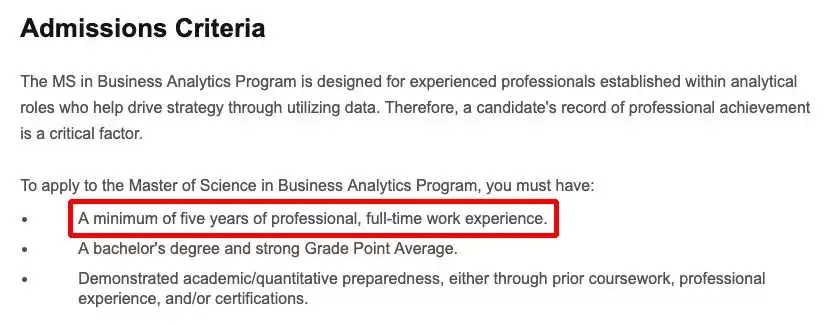
*NYU BA program application requirements
Overall, applying to Business Analytics is challenging. There are few BA programs, a large number of applicants, and the bar rises year by year with some fluctuation.
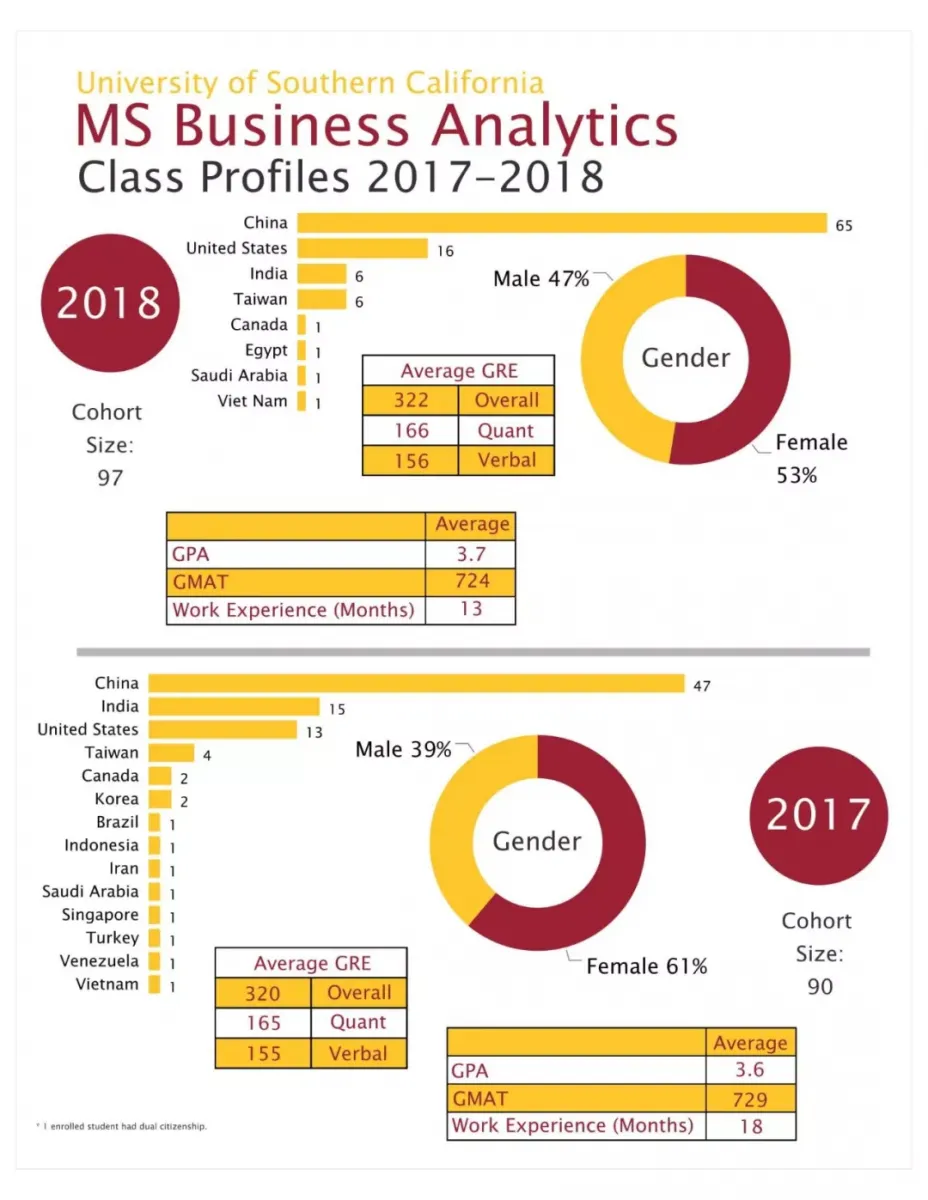
*USC BA program class profile
A matching undergraduate background, GPA 3.5+, GRE 320+ or GMAT 700+, and substantial relevant work experience are the basic standards for BA applications. The specifics also vary by school and student.
4. Which schools offer BA-related master's programs?
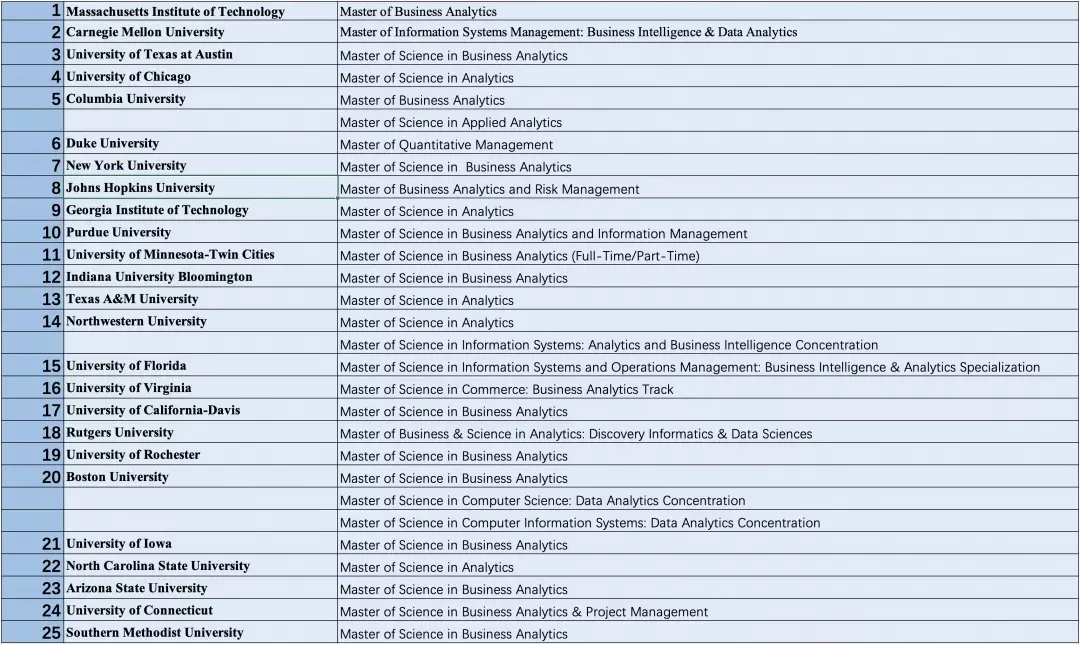
Based on U.S. News rankings, school curricula, and employment outcomes, CheersYou(清柚教育) has compiled the following list of 25 schools with Business Analytics-related master's programs (in no particular order, for reference):
Massachusetts Institute of Technology
Master of Business Analytics
Carnegie Mellon University
Master of Information Systems Management: Business Intelligence & Data Analytics
University of Texas at Austin
Master of Science in Business Analytics
University of Chicago
Master of Science in Analytics
Columbia University
Master of Business Analytics
Master of Science in Applied Analytics
Duke University
Master of Quantitative Management
New York University
Master of Science in Business Analytics
Johns Hopkins University
Master of Business Analytics and Risk Management
Georgia Institute of Technology
Master of Science in Analytics
Purdue University
Master of Science in Business Analytics and Information Management
University of Minnesota-Twin Cities
Master of Science in Business Analytics (Full-Time/Part-Time)
Indiana University Bloomington
Master of Science in Business Analytics
Texas A&M University
Master of Science in Analytics
Northwestern University
Master of Science in Analytics
Master of Science in Information Systems: Analytics and Business Intelligence Concentration
University of Florida
Master of Science in Information Systems and Operations Management: Business Intelligence & Analytics Specialization
University of Virginia
Master of Science in Commerce: Business Analytics Track
University of California-Davis
Master of Science in Business Analytics
Rutgers University
Master of Business & Science in Analytics: Discovery Informatics & Data Sciences
University of Rochester
Master of Science in Business Analytics
Boston University
Master of Science in Business Analytics
Master of Science in Computer Science: Data Analytics Concentration
Master of Science in Computer Information Systems: Data Analytics Concentration
University of Iowa
Master of Science in Business Analytics
North Carolina State University
Master of Science in Analytics
Arizona State University
Master of Science in Business Analytics
University of Connecticut
Master of Science in Business Analytics & Project Management
Southern Methodist University
Master of Science in Business Analytics
Below are some specific introductions to a few BA-related master's programs:
Massachusetts Institute of Technology - Master of Business Analytics
MIT's Business Analytics program integrates the expertise of the Sloan School of Management with strong support from its Operations Research Center. MIT typically ranks at the top in technology rankings. Its BA program is of high quality, covering a substantial amount of content in the one-year format.
This program requires applicants to have a strong background in mathematics, computer science, or statistics; all applicants must submit GMAT or GRE scores.
Carnegie Mellon University - Master of Information Systems Management: Business Intelligence and Data Analytics
The MISM-BIDA is a hybrid program suitable for students interested in data analytics, management, strategy, and IT. The entire program requires 180 credits over 16 months. Students must also complete a 10-week summer internship.
Applicants often hold degrees in engineering, IT, physics, and related disciplines. All students must have completed at least one college-level computer programming course (with a grade of B or above). Over 70% of BIDA students have relevant work experience.
Columbia University - Master of Science in Applied Analytics
This program combines courses in data science, statistics, and business management, helping students learn how to use data knowledge to define, analyze, and solve problems. Students also have the opportunity to enter New York local companies and collaborate with analysts to create real business solutions.
The admission difficulty is relatively lower than other programs, with no clear preference for applicant background; GRE/GMAT scores are recommended.
University of Minnesota-Twin Cities - Master of Science in Business Analytics
The BA master's program at the University of Minnesota Twin Cities focuses on technical skills, management theory, analytics, and advanced data science methods.
This program mainly admits recent graduates and early-career professionals with an analytics background, and it prefers applicants with some computer programming experience. GRE or GMAT scores are required.
In an era where everyone wants to work with "data," BA has become a massively popular field. However, there are still not many schools offering this program. The top ten schools on the list above are particularly competitive.
Therefore, CheersYou(清柚教育) suggests the following to students:
-
Don't blindly follow the crowd. Applicants should be clear about their own goals, strengths, and weaknesses before deciding whether to apply for this program.
-
Don't just fixate on the BA title; consider related programs as well. For example, Duke's Quantitative Management, Columbia's Applied Analytics—their course content is aligned with the purpose of BA, all dealing with data and statistics.
-
Finally, students who are strongly interested in Business Analytics should start preparing early, enhance their undergraduate backgrounds, and equip themselves to stand out in the competition.
That's all for today's introduction! Perhaps you may also want to learn about:
Data Analytics: Data Science 2020 Latest Application Trends: How to Choose Related Programs?
Computer Science: Applying for CS When Demand Exceeds Supply? See How the Wise Turn 'Retreat' into Advance!
Data Science: Senior's Sharing: What Kind of People Are Suited for DS, and What Development Awaits After Studying DS?