Why Doesn't Neighboring Canada Have Admissions Scandals?
The reason bribery scandals keep occurring at U.S. universities is partly due to American society's elite complex.
The fierce competition to enter top-tier universities has always been a hallmark of the U.S. higher education system.
However, surveys conducted by the consulting firm HESA of Canadian parents in recent years show that they really don't care about rankings.
Canadian universities do not differ greatly in quality or social returns. It’s not like the U.S., where only graduates from top universities can land top jobs.
Canadians know that the local university may not be the best in the country, but it’s good enough to fulfill its educational role. Students don’t have to go through brutal admissions competition, and most enjoy economic opportunities equal to or even better than those in the U.S. after graduation.
Additionally, wealthy Americans illegally exploit weak points in the admissions processes of most elite universities, such as sports coaches who have significant influence over admissions.
Canada’s university admissions system differs from that of the U.S.
Canada’s higher education system is characterized by most public universities (all top-ranked Canadian universities are public) using a more simplified admissions process.
Students are not admitted because they are good at tennis or because their parents are alumni. As Simon Marginson, professor of higher education at the University of Oxford, says: 'Donations won’t get you into the University of Toronto, and of course, backdoor routes like sports are not very important.'
Canadian universities primarily admit students based on their transcripts and GPA.
If your high school grades exceed the undergraduate admission cutoff, you can get in. Most schools do not require essays or recommendation letters, and there are no standardized tests like the SAT or ACT.
For Chinese international students, Canada is one of the few countries that recognize Gaokao scores. When applying to Canadian undergraduate programs, you can use your Gaokao and Huikao results.
Canada has long been a popular study destination next to the U.S. Besides the differences in admissions systems, studying in Canada offers many unique advantages.
Tuition
Higher education in Canada is more affordable than in the U.S.
The average annual tuition for international students at Canadian universities ranges from CAD 20,000 to 40,000 (approximately USD 15,000 to 30,000), compared to around USD 30,000 for U.S. public universities and USD 50,000 for private ones.
Therefore, in terms of cost, studying in Canada is more affordable.
Work
After graduating from a Canadian higher education institution, as long as the program duration is longer than two years, you can apply for a post-graduation work permit of up to three years. (Undergraduate programs and most master’s programs meet this condition.)
In contrast, the U.S. only offers a one-year post-graduation work permit (with a two-year extension available for STEM programs), so Canada’s work permit policy is more favorable and flexible for international students in humanities and social sciences.
At the same time, Canada has also relaxed its post-graduation work permit policy this year. The application period has been extended from 90 days to 6 months (180 days) after graduation, and a valid study permit is no longer required when applying for the work permit.
With the Trump administration’s increasing restrictions on work visas, post-graduation immigration status has become a headache for many international students in the U.S. In comparison, Canada’s more relaxed work visa policy has made it a preferred choice for many.
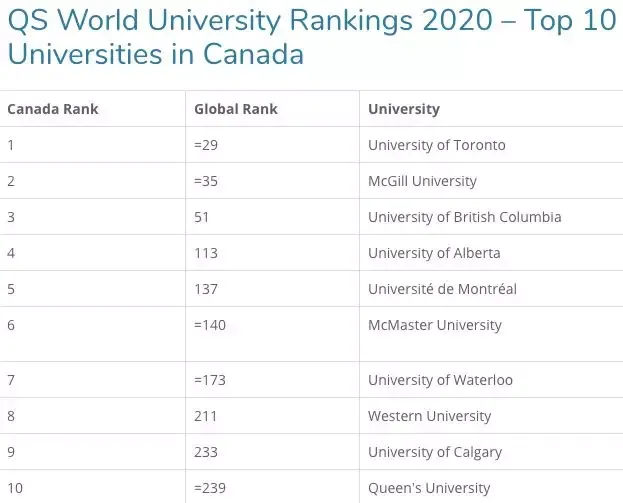
2020 QS Canadian University Rankings:
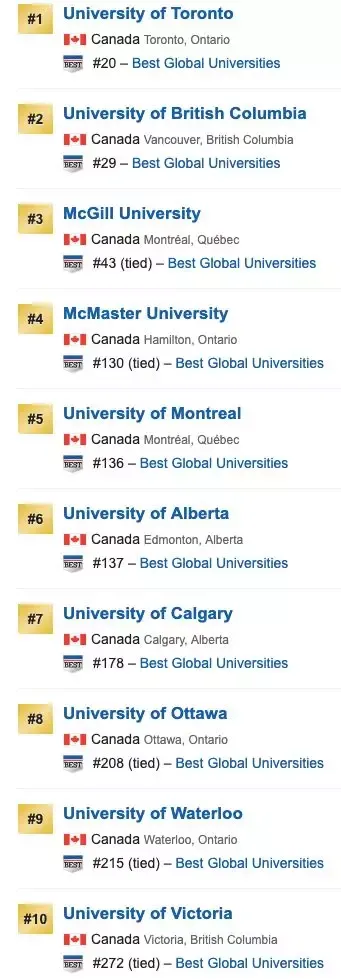
2019 U.S. News Canadian University Rankings: