When applying for graduate studies abroad, the choice of major and program is a primary consideration for many students. However, the variety and number of programs are vast, especially with the large number of U.S. institutions and the recent proliferation of new majors and interdisciplinary fields, making many graduate program names very similar, though what is studied and the career field may be completely different.
Here, CheersYou(清柚教育) has compiled some confusing popular major names in American universities:
Finance vs Financial Engineering vs Financial Mathematics
First, the highly sought-after finance-related majors: In annual U.S. business school applications, more than one-third come from finance-related fields. While traditional Finance, as well as the recently emerging Financial Mathematics and Financial Engineering, share similar names, their research methods and post-graduation career fields are not the same.
Finance
The core curriculum of a Master’s in Finance focuses more on investment analysis, corporate finance, financial management, or financial administration. As for foundational courses, applicants are generally expected to have prior coursework in economics, accounting, and statistics.
U.S. Master’s in Finance programs can broadly be categorized into two orientations: financial markets and quantitative analysis. Their main sub-fields (a single program may cover multiple areas) include capital markets, corporate finance, risk management, quantitative analysis, and financial engineering.

Financial Engineering
In recent years, with constant financial innovation, financial markets have become increasingly complex. Beyond traditional stocks and bonds, a series of new investment tools such as futures and options have emerged, collectively known as financial derivatives.
Pricing these financial derivatives is a challenge faced by investment banks. At the same time, the need to design sophisticated investment portfolios for profit has given rise to an interdisciplinary field that understands both financial markets and mathematical applications. Financial Engineering emphasizes backgrounds in mathematics and computing, using mathematical tools to model financial markets and solve financial problems. Unlike Finance, Financial Engineering places greater value on mathematics, programming, work experience, and financial-economic knowledge.
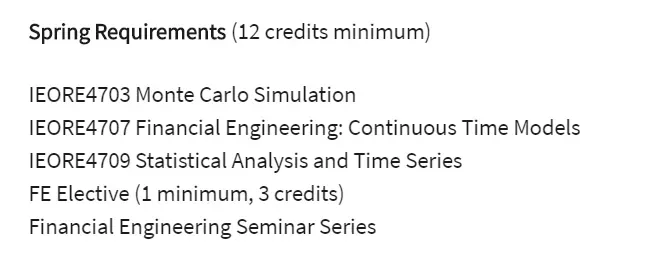
Columbia University’s Financial Engineering program spring course requirements:
Financial Mathematics
Financial Mathematics, also known as mathematical finance, quantitative finance, or analytical finance, is a discipline that uses mathematical tools to study finance, employing quantitative analysis such as mathematical modeling, theoretical analysis, and numerical computation to discover intrinsic patterns in finance and guide practice. It is similar to Financial Engineering, but with slight differences in curriculum; Financial Mathematics leans more toward the application of modern mathematics and computational technology in finance.
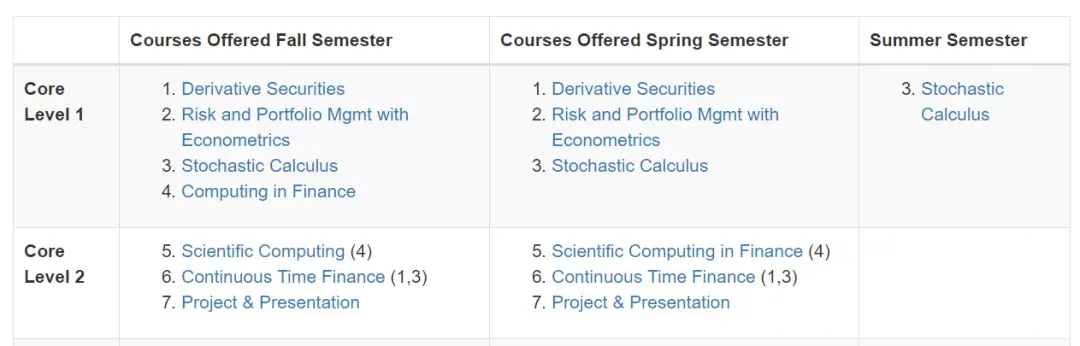
NYU’s Financial Mathematics program includes a large number of statistics courses:
Computer Engineering vs Computer Science
Computer Engineering
Computer Engineering combines many foundational elements of engineering and computer science. In addition to mastering programming skills, Computer Engineering students must also be familiar with electrical engineering knowledge, particularly circuits, electronics, VLSI design, and more.
Important directions in this field include embedded systems, networking, machine intelligence, computer software, and cybersecurity. Computer engineers drive technological progress by creating smaller, faster, and smarter machines, using their knowledge to embed computers into systems and establish networks for sharing information. Foundational courses include microprocessors, principles of electronics, electronic system design, computer organization and architecture, circuit principles, etc.
Computer Science
Computer Science is the study of the nature, rules, and problems of automated computation itself. Compared to Computer Engineering, Computer Science focuses more on theoretical research (the nature, rules, operations of automatic computation, etc.), and in application, it leans more toward software, emphasizing problem-solving based on computer technology. Programming is typically the research focus, and career directions tend toward application development fields such as development, testing, training, and technical research.
Johns Hopkins University’s CS Master’s program prerequisite requirements for applicants:

Education vs Teaching
Education
Education is a field that studies macro-level education, covering areas such as multicultural education, education policies in different regions, and the laws of learning acquisition. Typically, a master’s in Education is awarded as a Master of Education (MEd). Unlike Teaching, an MEd does not emphasize the teaching techniques of a specific subject, but rather focuses on research into education policy, educational technology, and the patterns of educational development.
Teaching
A Master of Arts in Teaching (MAT) is a degree program focused on practical teaching applications and specific subject knowledge. Unlike the MEd, MAT programs are highly practice-oriented, and at some institutions, graduates may simultaneously obtain a teaching license, often pursuing careers in the teaching profession.
The above are just some of the commonly confused U.S. graduate program names. There are many other similar-sounding but different majors, such as Pharmacy vs. Pharmaceutical Engineering, Environmental Science vs. Environmental Engineering, Social Work vs. Social Sciences, etc. When applying, students must do their research—not only reviewing program introductions but also checking whether the courses taught align with expectations.