
Recently, a U.S. federal judge finally ruled that Harvard College's undergraduate admissions process did not intentionally discriminate against Asian-American applicants. After more than a year of trial, Harvard won this admissions discrimination lawsuit.
This lawsuit originated in 2014, when a non-profit organization called "Students for Fair Admissions" (hereinafter "SFFA") filed a suit alleging that Harvard used discriminatory admissions policies against Asian-Americans, limiting the number of Asian-American applicants admitted. The case went to trial on October 15, 2018.
SFFA President Edward Blum argued that Harvard overused "racial balancing" strategies, establishing racial quotas in admissions.
.png?x-oss-process=style/opt-webp)
SFFA claimed that, in order to achieve its racial balancing goals, Harvard set higher admissions standards for Asian-American applicants than for other ethnic groups, a practice that violates civil rights law.
They also analyzed over 160,000 student application files and found that Harvard's personality ratings for Asian-American applicants were consistently lower than those for other ethnic groups. The personality ratings mainly include factors such as "positive personality, popularity, courage, and kindness."
In other words, did Harvard admissions officers, without even meeting the students, simply deem Asian-American students as lacking "kindness"?
.png?x-oss-process=style/opt-webp)
Of course, Harvard disagreed with this claim. The university rallied 16 prestigious schools, including Yale and Stanford, and 36 organizations to defend its admissions process.
Harvard stated that there is no discrimination against any ethnic group in its admissions process and that it firmly upholds its holistic review admissions policy. On this point, the presiding judge in the case, Allison D. Burroughs, sided with the defendant, finding that Harvard's consideration of race in admissions complies with strict constitutional standards.
Whether there truly is discrimination against Asian-Americans in the admissions process is hard to say. Both Harvard and SFFA have their own arguments, emphasizing that different analytical methods applied to admissions data may yield different results.
So, let's take a look at Harvard's admissions preferences and enrollment trends in recent years to analyze whether this top university really engages in racial discrimination.
Harvard Admissions Preferences
For Asian-American applicants to have the same admission chances as other ethnic groups, their SAT scores (out of 1600) need to be 140 points higher than those of white students, 270 points higher than those of Latino Americans, and 450 points higher than those of black students.
.png?x-oss-process=style/opt-webp)
From the current perspective, the outcry about discrimination against Asian-Americans arises because most Asian-American students have higher standardized test scores like the SAT than students from other countries. Besides test scores, other factors also influence Harvard's admissions decisions.
Soft Skills
For example, students' extracurricular activities, leadership, and breadth of interests. Colleges care more about what interests students developed during their growth and what contributions they have made to society; these are far more attractive than students who only focus on academic study.
.png?x-oss-process=style/opt-webp)
.png?x-oss-process=style/opt-webp)
Early Applications
American universities generally have three admission options: ED (Early Decision) and EA (Early Action) are early admission, while RD (Regular Decision) is regular admission.
Among those admitted to Harvard, 54.8% entered through early applications; only 28% were admitted through regular decision. It can be seen that students who apply early have a greater chance of being admitted, though the premise is that they are still outstanding enough.

Harvard Admissions Data
Among the Class of 2023, white students account for 47%, 11% are Latino, 10% are African American, and Asian-American students make up over 22%, remaining the second-largest demographic group. Last year, Asian-American students accounted for only 18%; compared to last year, Harvard admitted more Asian-American students this year.
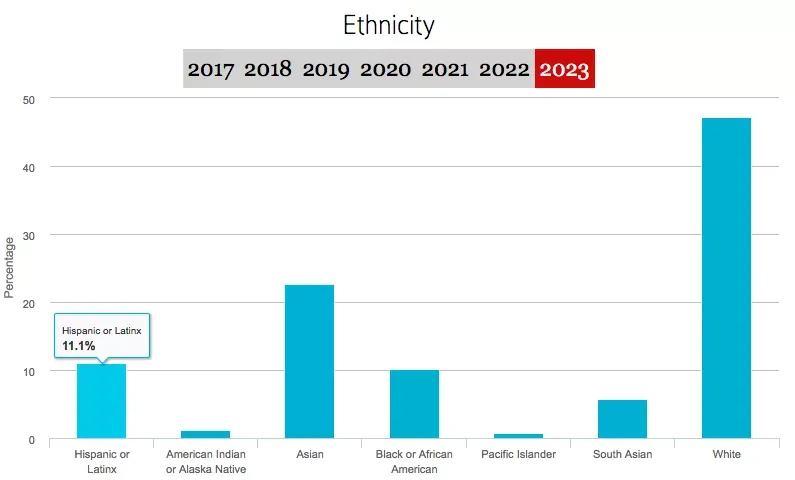
However, whether this change in proportion is a result of public pressure is unknown.
Educational Equity: A Long Road Ahead
According to the judge's ruling, Harvard's admissions program is "not perfect," but "there is no evidence of any racial animus."
Although educational equity and fairness in resources are goals we have always pursued, there is still a long way to go on this path.
It is right to fight for one's rights, but one must also strive to adapt to the real world, for absolute and pure fairness is a rare thing.
Finally, we hope everyone can apply to the school that best suits them, rather than blindly chasing the so-called "best" school.