The winter solstice is approaching, and the festive month of December has arrived. While looking forward to the holidays, students should not forget that the application deadlines for UC graduate programs are looming!
Like undergraduate applications, UC graduate deadlines tend to be early. However, when it comes to applying for UC graduate programs, students often describe it as a "trail of tears."
Unlike undergraduate applications, graduate applications require far more time and effort. For UC schools, the admissions process is even more complex.
Yet, while undergraduate enrollment in California is plentiful, countless students hit roadblock after roadblock when applying to graduate programs. This prompts the question: Why is applying to UC graduate programs so difficult?
Challenge 1: Few Highly Ranked UC Schools to Choose From
Overall, admission to graduate programs tends to be less competitive than undergraduate, and graduate studies are more closely tied to career paths. So many students aim for top-50 or even top-30 schools.
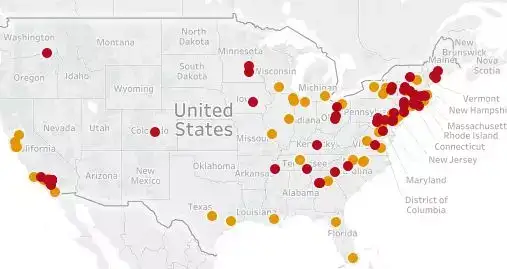
However, over 80% of the top 50 schools are located on the East Coast, not in California, and the number of top-30 UC options is even fewer.
Meanwhile, the number of graduate applications continues to rise each year, and applicants clamor to get into elite UC campuses like UCLA and UC Berkeley.
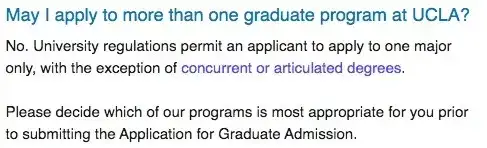
Not only are top school choices limited, but the number of graduate programs available at UC schools is far fewer than on the East Coast. UCLA and UC Berkeley both explicitly state that applicants may apply to only one graduate program. This rule makes it even harder for students.

Challenge 2: Small Cohort Sizes
While the graduate admission rates between East and West Coast schools are not drastically different, total enrollment numbers differ enormously.
Take UC Berkeley and NYU, for example:
In 2018, UC Berkeley enrolled a total of 3,181 graduate students. Among them, the popular College of Engineering admitted 771, the College of Letters and Science 434, and the Haas School of Business only 85.
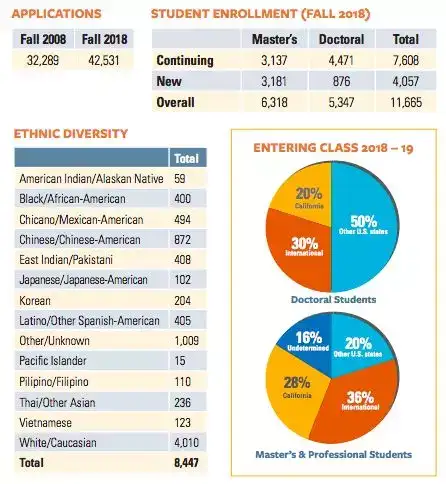
In contrast, NYU's Graduate School of Arts and Science alone enrolled 4,111 students, the Tandon School of Engineering 1,242, and the Stern School of Business 739.
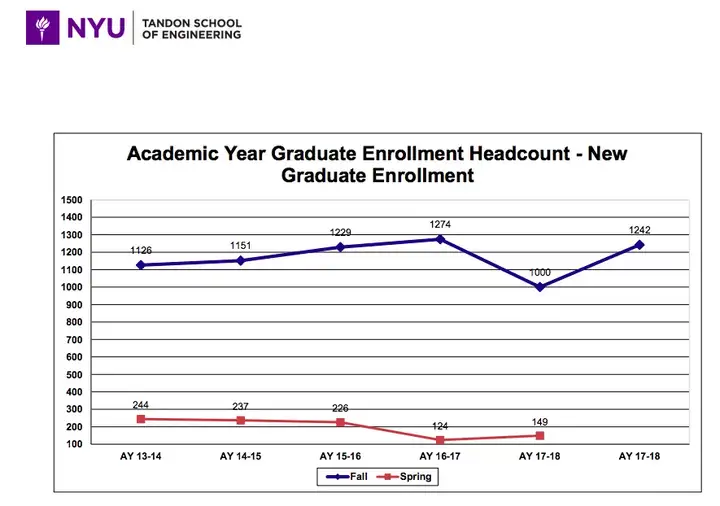
By comparison, it's clear that UC graduate enrollments are much smaller, so admissions committees are naturally more selective and demanding.
Challenge 3: Sky-High Requirements for Popular Programs
Stanford and Caltech are notoriously difficult, with top-tier applicants battling it out, and they offer predominantly PhD programs.
USC and the UC system are also infamous for their strict cutoffs; popular programs have extremely demanding requirements.
Here are the average profiles for a few frequently applied popular programs to give you a sense:
UCLA - M.S in Computer Science
Average GPA: 3.6
Average GRE: Verbal 156, Quant 168
UC Berkeley - M.Eng in Electrical Engineering & Computer Sciences
Average GPA: 3.7
Average GRE: Verbal 72%, Quant 91%
USC - M.S in Business Analytics
Average GPA: 3.7
Average GRE: Verbal 156, Quant 166
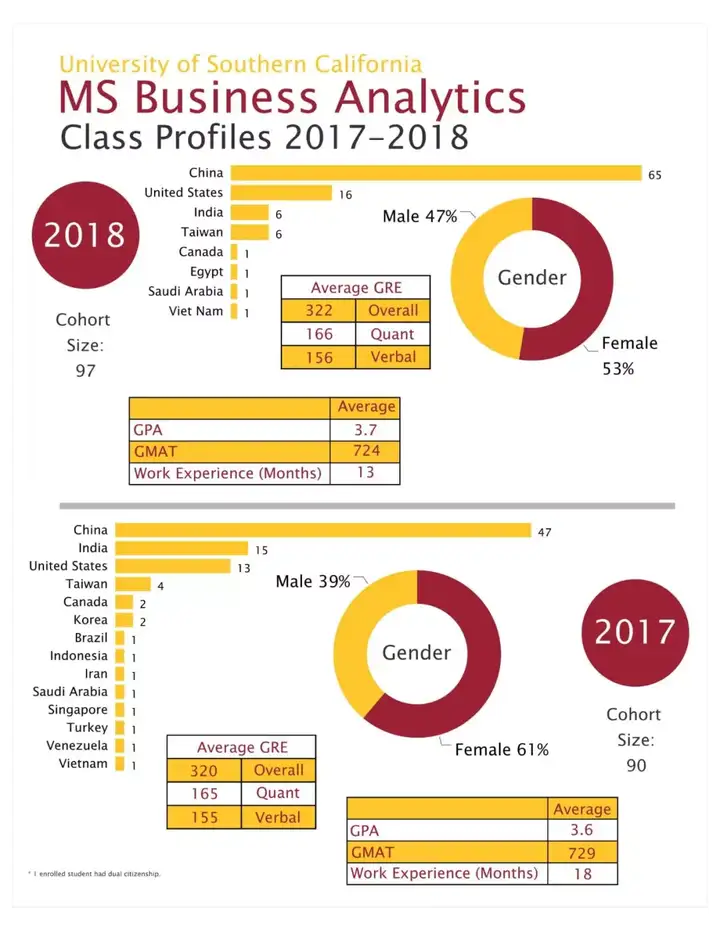
As you can see, for competitive programs, GPAs are typically 3.6+ and GRE scores need to be 325+ to be competitive. The actual bar may be even higher.
Many of these programs also favor applicants with work experience, which is less favorable for international students applying directly after undergraduate studies.
These challenges are all too familiar to students applying to UC schools. We strongly recommend not putting all your eggs in one basket and also considering East Coast schools.

East Coast schools offer a wider variety of graduate programs, increasing the chances of being admitted to your desired field.
This is especially true for humanities and business fields like finance, economics, history, education, political science, and psychology—top East Coast schools, including the Ivy League, are excellent choices.
With New York's elite networking, Boston's academic culture, and Washington, D.C.'s political atmosphere, the East Coast is rich in cultural heritage, steeped in traditional social etiquette, and highly urbanized.

Moreover, the East Coast offers broader job prospects, more networking opportunities, and a faster pace of work and life, making it a better fit for students looking to grow rapidly.
That's why many UC undergrads choose to pursue graduate studies on the East Coast.