Waiting tables during spare time between experiments; mixing cocktails at a bar after finishing lab work at night; having to abruptly change a long-term research direction due to funding availability...
This is the doctoral life of Marina, a third-year chemistry student at the University of Novi Sad in Serbia. She represents a typical PhD student: overworked, overstressed, and facing an uncertain future.

For a long time, people have regarded a PhD as the ultimate academic goal. Becoming a doctoral student has been equated with coveted research opportunities and a bright future.
However, the fifth survey of PhD students conducted by Nature, one of the world's most authoritative scientific journals, once again shatters this traditional perception, revealing the enormous efforts doctoral students must make in facing pressure and uncertainty, and in combating depression and anxiety.
This survey of more than 6,300 young researchers from various scientific fields around the globe digs deep into the lesser-known side of doctoral students, including work-life balance, career prospects, debt, and mental health issues, exposing the turbulent essence of doctoral life.
PhD students suffer from mental health challenges
Unlike the previous four surveys, this one included questions about mental health for all respondents—a sign that the researchers sensed some of the more troubling effects of higher education.
As expected, more than a third of respondents reported having sought help for anxiety or depression caused by their doctoral studies.
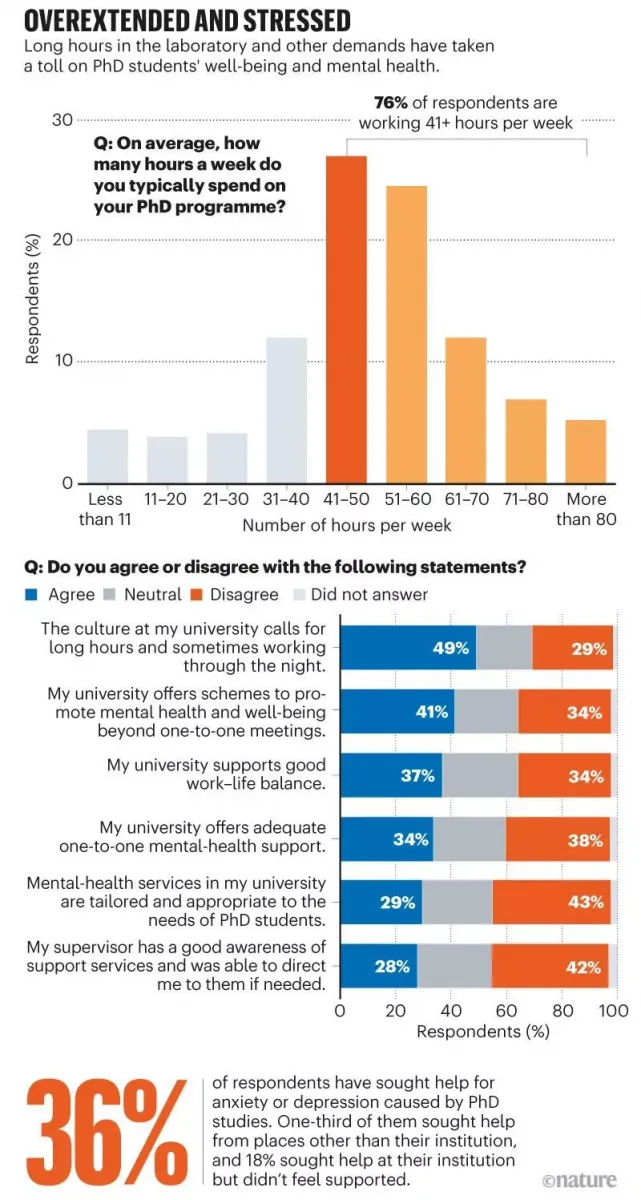
This finding aligns with other surveys on student mental health. An international survey published by the World Health Organization in 2018 found that 31% had shown signs of mental disorders such as major depression, generalized anxiety disorder, or panic disorder.
The mental health of PhD students can be said to be even more severe. Statistics show that nearly 40% of surveyed doctoral students indicated they are studying abroad as international students.
In the United States, a PhD typically takes five years to complete, but many students take longer—some even six years or more. This means a doctoral student may have to study and live alone in a foreign country for over five years.
Beyond the arduous academic journey, actually earning a PhD in the U.S. is not easy. Even after completing all coursework, one must successfully pass the final dissertation defense. Without both, a PhD will not be granted. The fear of wasting years of time and effort adds immense pressure, making psychological issues more prevalent.
Gradual decline in satisfaction with doctoral programs
While three-quarters of doctoral students are satisfied with their level of independence, 45% of respondents reported that as they delve deeper into their research projects, their satisfaction with the doctoral program gradually declines.
Nearly 40% of respondents said the program did not meet their expectations, and only 10% said it exceeded them. To put that into perspective, the proportion of those whose expectations were exceeded was 23% in the 2017 survey.
Many PhD students, full of enthusiasm and eager to excel in scientific research, gradually find that doctoral programs may not be right for them. Some students initially chose a PhD because they wanted to focus solely on academia and avoid networking, only to discover that interpersonal relationships in the lab are even more complex, with many factors to consider.
Zhou Yang, a Chinese international student who participated in the survey, said he encountered unexpected challenges when he came from China to pursue his PhD in California.
"I thought I only needed to care about research, but later I realized I also had to worry about lab relationships and communicating my research to the outside world. There are so many things to consider beyond just doing experiments."
Even though PhD students are typically outstanding in many ways, in a program filled with brilliant minds, many begin to doubt themselves: Should I really be here?
Doubts about future prospects
Even if they eventually graduate, whether the payoff is worth the effort remains a major concern for doctoral students.
In the survey, only 26% of respondents felt that their program could "very well" help them achieve a satisfactory career.
Many PhD students worry about debt during their studies and financial pressure after graduation. The degree of concern varies by region, with a higher proportion of respondents in Africa and Asia expressing debt-related worries.
Despite a continuing shortage of academic jobs at universities and colleges worldwide, a striking 56% of respondents still said they would choose to "face the challenge head-on," given that academia remains the top choice for most doctoral graduates. But with ever-increasing competition, the difficulty of making a career in academia is evident.
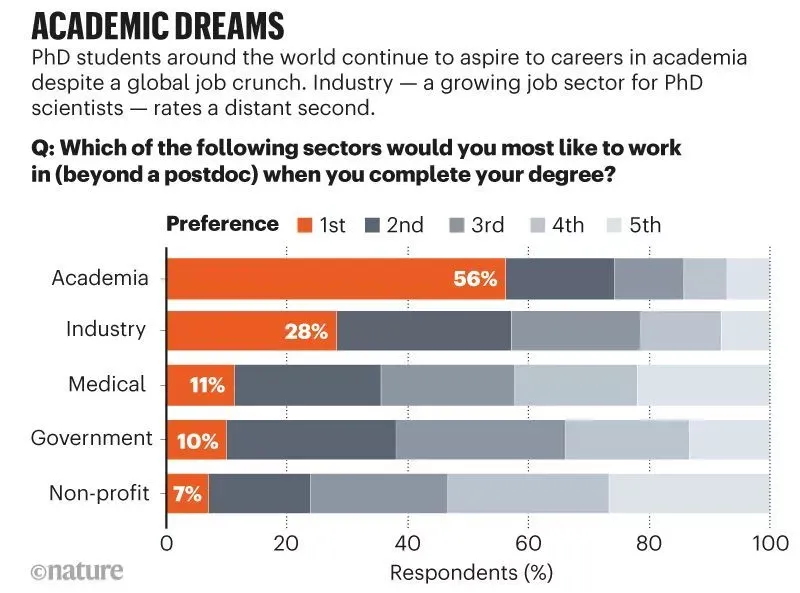
Even if they give up on academia and seek employment in the industry, PhD holders face significant hurdles. Suitable positions are usually in corporate R&D departments, but if a PhD applies for a role also open to bachelor's or master's graduates, there's a high chance they will be deemed overqualified and rejected.
Pursuing a PhD is a grueling journey marked by constant self-doubt and uncertainty. Many students question whether they made the right choice and wonder where their efforts are leading.
Only those who manage to endure the setbacks and negative emotions, accept the uncertainty of the future, and remain calm under pressure can ultimately emerge as winners. Those who cannot bear the stress mostly leave the PhD path early.
Why choose a master's when direct PhD from bachelor's is possible?
While direct PhD admission after a bachelor's degree is possible in the United States, amid these current difficulties, more and more undergraduates are rethinking their views on pursuing a doctorate.
In fact, for most undergraduates, a master's degree is sufficient for enhancing academic literacy and paving a career path.
First, the requirements for direct PhD applications are very high. Excellent standardized test scores, rich research experience, strong letters of recommendation, and outstanding essays are all necessary.
This is not something all undergraduates, especially international students, can easily achieve. It requires investing significant time and effort from day one in finding internships and building relationships with professors, which may not be worth the cost.
Unlike doctoral programs that emphasize theory and research, master's programs focus more on practice and experience. Many programs even require internships, which greatly helps students who plan to enter the job market directly after graduation.
This is also why many students who are qualified for PhD applications choose a master's degree instead. After all, the future prospects brought by a master's degree are clearer than those of a PhD. Even if they later decide to pursue a doctorate, the prior master's experience provides good preparation and reference.
In summary, pursuing a PhD, especially a direct PhD from a bachelor's, is a decision that warrants careful consideration. A master's requires less deliberation and offers broader life opportunities down the road.
Of course, the final decision always rests with the student. If a PhD is truly the right path for you, be fully prepared and maintain a firm resolve to face the complex reality of doctoral life.
If you are not yet ready, give yourself a bit more breathing room.