On September 23, QS released the latest 2022 QS Graduate Employability Rankings.
This year's ranking features 550 institutions, 50 more than last year, making it the largest-ever QS Graduate Employability Rankings.
Higher education is one of the most important investments, and post-graduation employment outcomes are a key concern for many families of international students.
What does this year's latest QS ranking look like? Let's find out!
QS Ranking Indicators
The QS Graduate Employability Rankings primarily assess university performance in terms of graduate employment outcomes and prospects.
Each institution's score is composed of five carefully selected indicators. Except for employer reputation, all currently used indicators are unique to the QS rankings.
The specific indicators and their weights for this ranking are as follows:
1. Employer Reputation 30%
2. Alumni Outcomes 25%
3. Employer Partnerships 25%
4. Employer-Student Connections 10%
5. Graduate Employment Rate 10%
QS Ranking Highlights
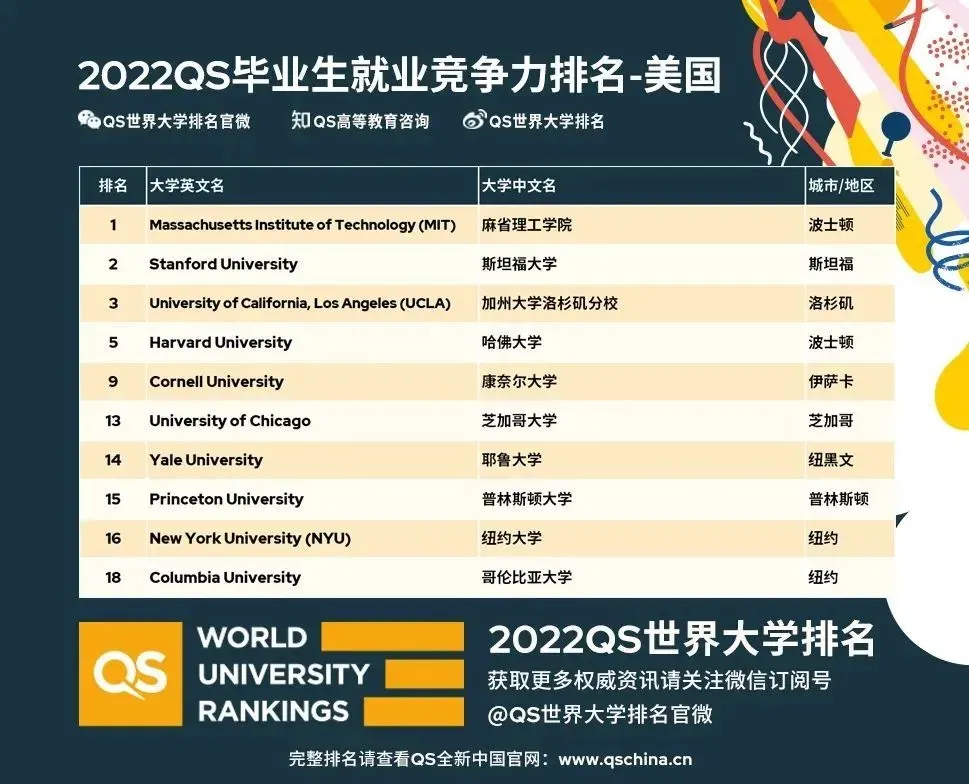
This year, the top three in the QS ranking remain unchanged for the third consecutive year, all from the United States: Massachusetts Institute of Technology (MIT), Stanford University, and University of California, Los Angeles (UCLA).
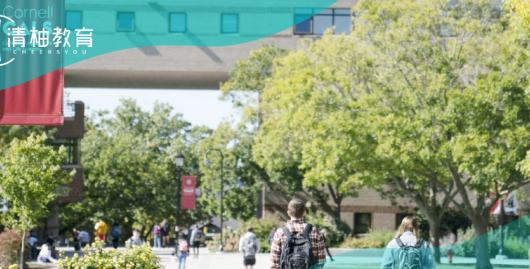
Another top US university, Cornell University, rose from 12th place last year to 10th this year.
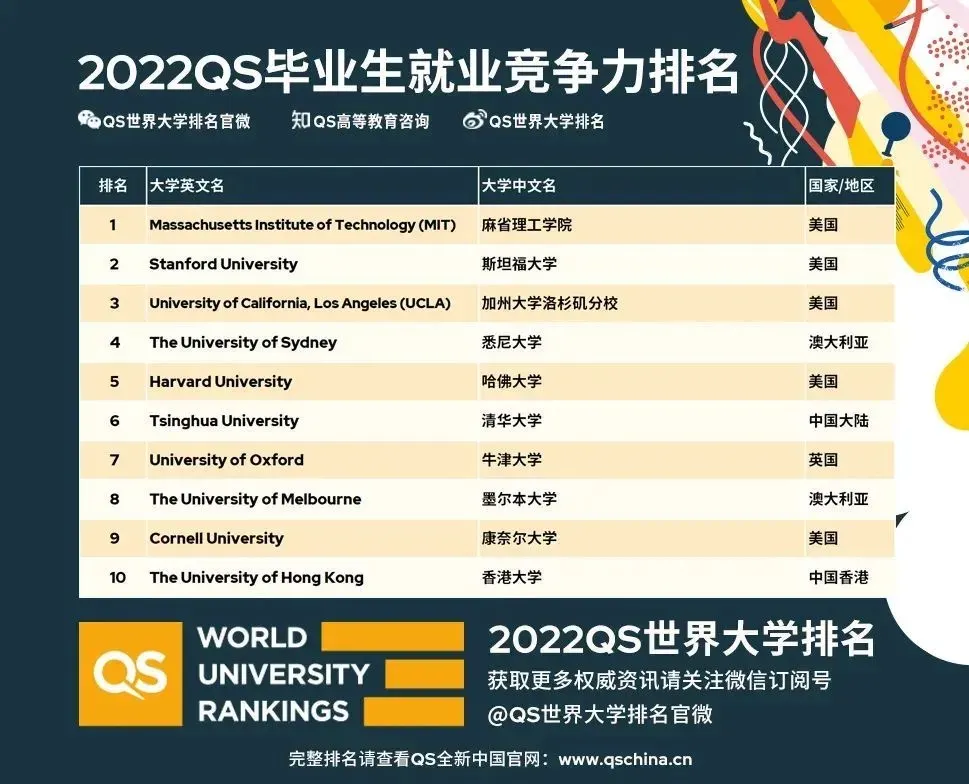
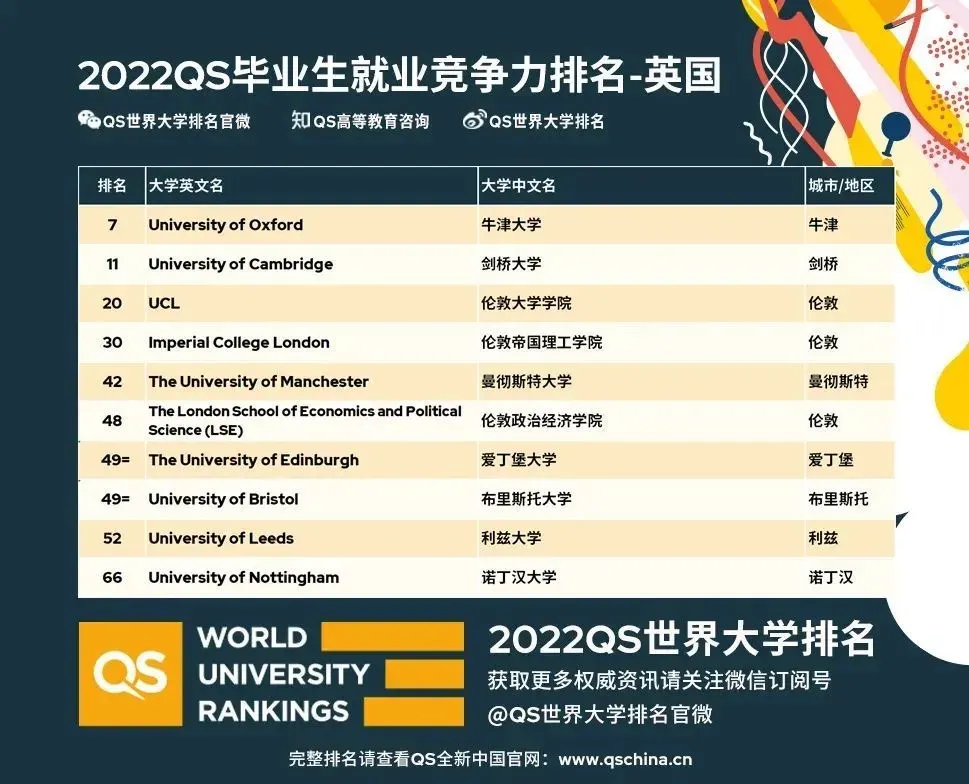
The United States continues to dominate the QS employability rankings, with 90 universities featured; the United Kingdom follows with 54 universities; mainland China and Japan each have 22 universities on the list.
In terms of specific sub-indicators, MIT, Stanford, Harvard, and Oxford performed best in employer reputation and alumni outcomes, all achieving perfect scores of 100.
Singaporean institutions achieved the highest scores in employer partnerships; Singapore is also one of the top five countries in this indicator.
This time, a total of 22 Chinese universities made the list, with 11 in the world's top 200, 5 in the top 100, and Tsinghua University breaking into the top 10 globally at 6th place.
Moreover, Huazhong University of Science and Technology achieved a perfect score of 100, ranking first in the world for the employer-student connections indicator.
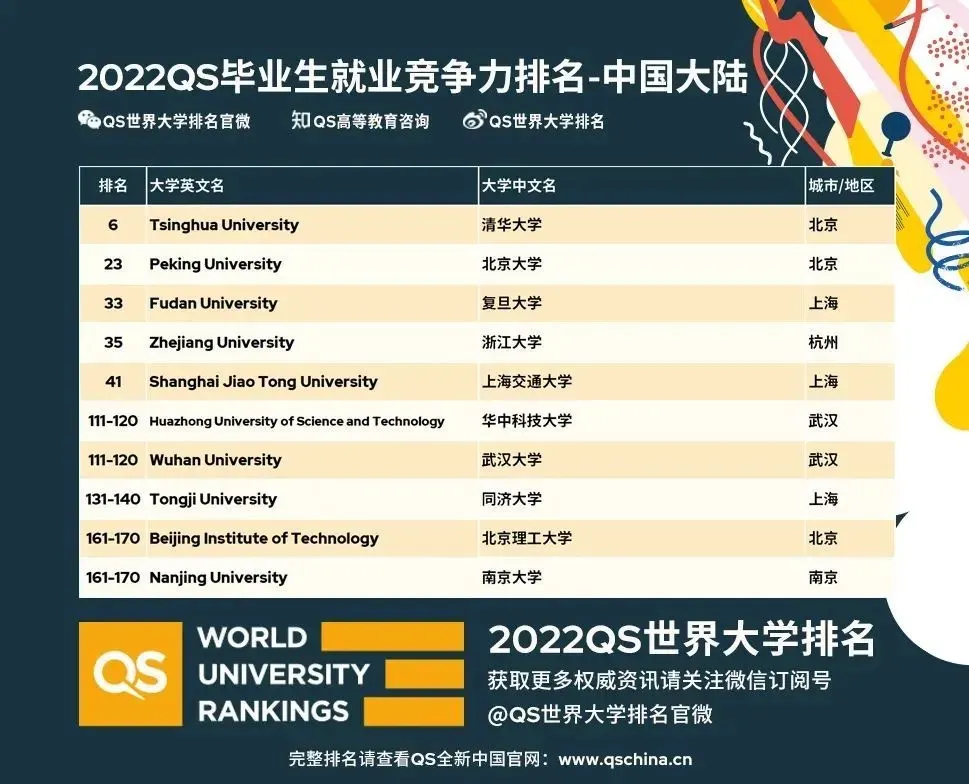
To view the full 2022 QS Graduate Employability Rankings, visit: https://www.qschina.cn/university-rankings/employability-rankings/2022
The QS Graduate Employability Rankings offer a useful reference for students from an employment perspective. However, it is also evident that these rankings downplay factors such as academic reputation, student quality, and faculty strength that many value in a university.
Rankings should still only be used as a reference. Rankings alone should not be the sole basis for university applications.
When choosing a university, you should also comprehensively consider all aspects of the institution and fully integrate your own background and preferences to make a rational, personalized choice.
News source: QS World University Rankings