It's the start of the school year for many American universities. But for Chinese international students, things seem to be getting harder.
International students have been through a lot this year. Since last year, the Trump administration has restricted visas for Chinese students, especially graduate students in sensitive research fields, and has publicly warned biomedical researchers at American universities.
Before the school year began, nine Chinese students were detained and deported. After the start of the semester, it emerged that the FBI had approached multiple American universities, seeking their assistance in monitoring Chinese international students and scholars of Chinese descent.
A Letter to All Faculty and Students
In response, Columbia University President Lee C. Bollinger could not stand by. He published an article in The Washington Post titled “No, I Won't Start Spying on My Foreign-Born Students” and sent an email to all faculty and students stating that the FBI “encourages” Columbia to monitor foreign-born students and scholars, especially those of Chinese heritage, but he refuses to do so.
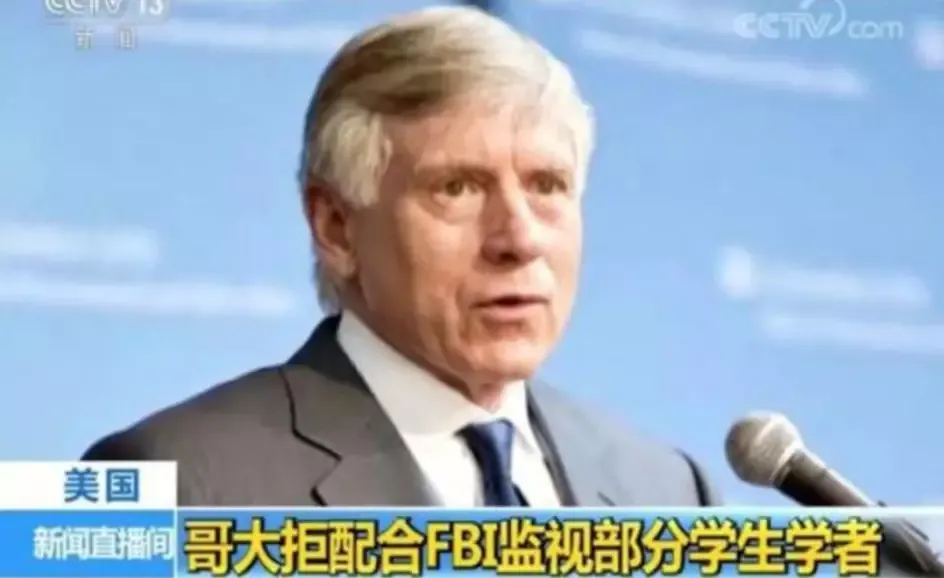
Rumors had long circulated that at least 10 members of the Association of American Universities had been approached by the FBI, including even two Canadian universities. President Bollinger's open letter essentially confirmed the rumors about FBI surveillance of foreign scholars.
Columbia’s faculty and students come from over 150 countries and regions. Bollinger believes that the strength of American higher education lies in the innovative competitiveness brought about by its high degree of inclusivity and openness. “Ironically, this is precisely what the FBI sees as our greatest weakness.” Bollinger stated he would not obey the U.S. government's orders and refused to cooperate.
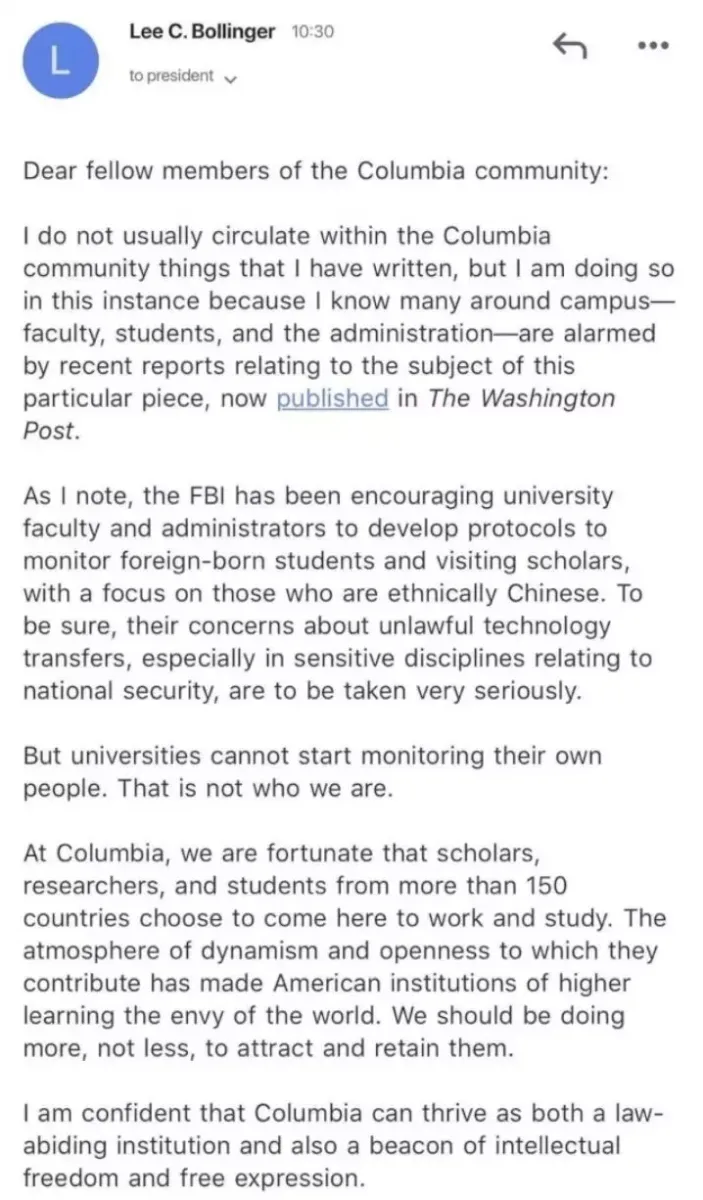
He believes that the notion that “universities should be required to monitor every move of foreign students and colleagues” is fundamentally at odds with being an educator.
At the end of the open letter, the president mentioned that he had proposed a more effective solution to the U.S. Commission on the Theft of American Intellectual Property: increasing the number of green cards issued to foreign graduates. This would encourage international scholars to stay in the U.S. instead of taking the knowledge gained back to their home countries.
After the letter was published, President Bollinger's stance received widespread support online. International students from various universities praised his spirit and perseverance.
New Student Convocation
Last week, the Columbia president once again addressed these issues at the new student convocation, delivering a speech titled “When the World Comes Apart, We Should Revere Knowledge and Seek Truth.”
.png?x-oss-process=style/opt-webp)
In his speech, President Bollinger reiterated the true value and essence of a university:
“A university is about knowledge, the pursuit of truth, uncovering the secrets of life and the nature we depend on, grasping and comprehending the complexity of existence. Its purpose is not to make a profit, exercise power, formulate policies, worship deities, engage in club activities, enjoy life, or build networks. These aspirations are not wrong in themselves, and a university cannot be entirely independent of them, but they do not constitute its essence.”
He also addressed the university's stance on political issues:
“In the world we face today, reverence for truth, reason, knowledge, courtesy, dignity, and human rights is gradually eroding. Universities should return to the essence of ‘seeking and respecting truth’ rather than taking sides on political issues like trade policy or immigration.”
Many other universities such as Yale, the University of Michigan, and UC Berkeley also urgently voiced their unwavering appreciation and support for international students, scholars, and global scientific collaboration.
.png?x-oss-process=style/opt-webp)
The U.S. is becoming increasingly “isolated” on trade and technology issues, and now it is promoting “spy theories” to obstruct academic exchanges between China and the U.S. Regarding this, Xinhua News Agency once commented: “This actually reflects the ‘inner demons’ of certain people in the U.S., and it undoubtedly creates unnecessary barriers to normal exchanges between the two countries in various fields.”
We sincerely hope that China and the U.S. can maintain normal exchanges and cooperation. Science knows no borders. Only with an inclusive and peaceful attitude can we promote genuine mutual progress.