The second week of 2020 has begun, and the lingering festive cheer of the new year is gradually giving way to the hustle of pursuing fresh goals.
This is especially true on the busiest streets of early morning New York, where people in suits and ties hurry past, heading to world-renowned banks like Merrill Lynch, Morgan Stanley, Goldman Sachs, Citibank...
As a new decade dawns, one thing remains unchanged: students' aspirations to join top-tier companies.
According to data from Indeed, starting salaries for analysts at Goldman Sachs can exceed 400,000, and after a few years of hard work, earning a million a year is no pipe dream.
Of course, the path to such a glamorous and high-paying job is anything but simple. The first hiring criterion for these elite firms is often: Are you from a Target School?
What is a Target School?
It's no secret that the finance, consulting, and accounting sectors each maintain their own Target Schools Lists. Firms prioritize and allocate recruitment resources first to universities on these lists.
Take investment banks for example—the Target Schools Lists of the Big Four investment banks are particularly strict. Statistics show that 75% of their employees come from schools on these lists.
Below are the Target School lists for front-office positions at Morgan Stanley and Goldman Sachs in 2019:
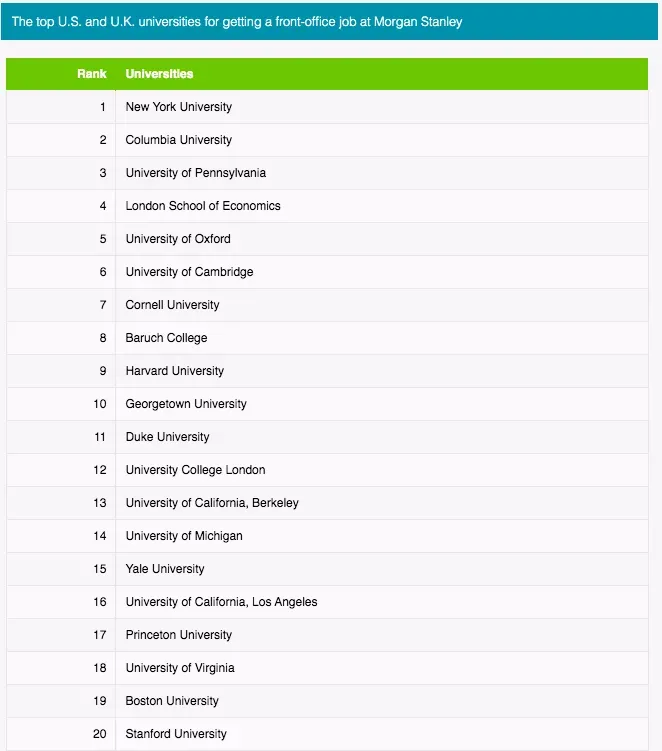
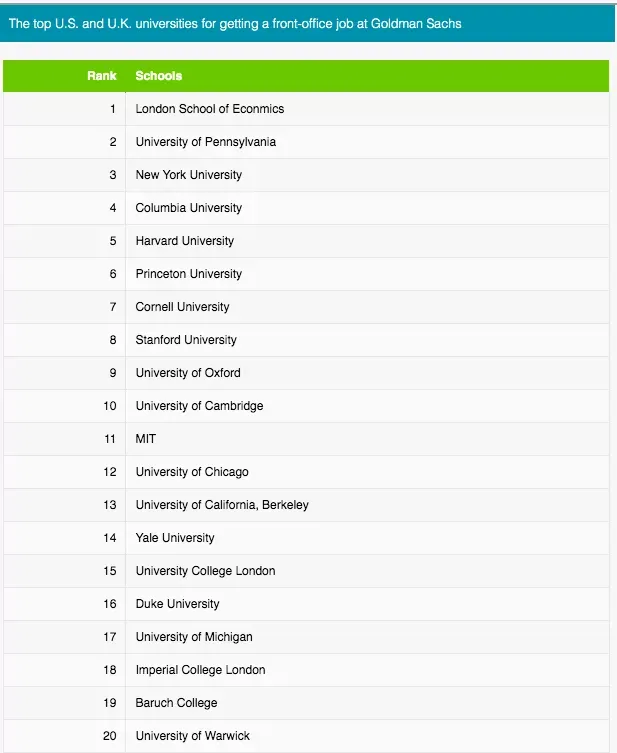
It's clear from the lists that NYU, Columbia, Cornell, Stanford, Princeton, MIT, and Harvard repeatedly appear for the U.S., solidifying their status as undisputed target universities.
What are the advantages of being at a Target School?
1. Access to separate online application channels
Prestigious firms send teams to participate in school career fairs and hold information sessions. After these events, students can submit applications through the school's internal job portal, with each school having its own application deadline.
2. Higher chances of securing subsequent interviews
Firms typically decide in advance how many interview slots to allocate to each school. After submitting applications, students from Target Schools have a significantly higher chance of receiving responses and interview opportunities.
Campus recruiters also conduct first and second round on-campus interviews at the university career center or nearby hotels.
3. More networking opportunities on a regular basis
In addition to recruitment resources and interview advantages, Target Schools boast strong alumni networks, making it far easier to network, connect with insiders, gain deeper industry insights, and even secure internal referrals when job hunting.
Some investment banks, Big Four firms, and consulting companies even organize pre-interview dinners the night before first-round interviews. These informal events allow them to get to know candidates and address their questions.
In summary, Target Schools do offer considerable advantages. Students aspiring to work in investment banking, the Big Four, or consulting should factor in whether a school is a Target School when applying to universities and choosing offers, to pave the way for the future.
Is it a lost cause if you are not from a Target School?
So, does not coming from a Target School mean you have no chance?
Not necessarily.
First, your school may not necessarily be at the bottom of the prestige chain. Beyond Target Schools, Semi-Target Schools also receive some attention from top firms, though the number of companies recruiting on campus is relatively limited.
Even if your school is truly a Non-Target School, it simply means you lack one potential advantage. Don't sell yourself short—your personal abilities matter most. You can boost your chances of landing a job in investment banking or the Big Four through the following methods.
1. A strong GPA is the entry gate
While grades don't represent everything, a solid GPA at least indicates strong learning ability and a diligent attitude.
Investment banks place great emphasis on academic performance, and job postings from the Big Four often list GPA requirements. So don't slack off—maintaining a high GPA is essential to even step through the door of these elite firms.
2. Relevant internship experience is the top priority
Past internship experience is another key metric firms use to assess your capabilities. Surveys show that nearly everyone who joins a top-tier firm completed 1-2 related internships beforehand. It's not just about quantity; the relevance of the internship company or role to your target position is far more important.
Additionally, lacking on-campus recruitment, networking during internships becomes especially critical. Building connections day by day may lead to internal referral opportunities.
3. CPA and CFA certifications are bonus points
Studying for the CPA or CFA hones your thinking and helps you quickly adapt to professional roles later. These certifications are great bonuses on the job hunt and are worth preparing for early.
For example, the CPA is highly difficult but often called the "stepping stone" to the Big Four. In finance, it's most relevant to investment banking, especially for those in primary market roles, and is highly recommended.
The CFA Level I materials are excellent introductory resources that organize knowledge across the financial industry. Much of the content is directly applicable to real-world work and greatly beneficial.
4. Taking an indirect path is a viable strategy
Competition at top investment banks is notoriously fierce. Choosing a smaller investment bank over a prestigious one isn't giving up—it's a tactical move. After accumulating enough experience at a smaller firm, successfully jumping to a larger one becomes much more feasible.
Furthermore, compared to front-office roles, middle and back-office positions like operations face considerably less competition. Targeting these roles, working diligently, and then leveraging internal networks to transition later is another clever approach.
The road to top-tier firms is demanding. GPA, networking, and internship background are all essential, and even after securing an interview, you can't relax—thorough preparation and outstanding performance on the spot are needed.
As a student from a Non-Target School, you must exert extra effort across multiple dimensions to stand out from the crowd of applicants.
Success isn't measured by a single standard, nor is joining a top-tier firm the only path to a fulfilling career.
Here, CheersYou(清柚教育) also reminds students to maintain a positive mindset while working hard. With diligent effort, the seeds of opportunity will surely bloom and bear fruit!