U.S. universities have extensive experience in psychology education and research, and the field of psychology covers a wide range with excellent career prospects. In recent years, many international students have chosen to pursue psychology in the U.S. As a result, psychology has not only become a popular choice for master’s applications, but many universities have also launched new psychology programs. So, what are the application requirements for a U.S. Master’s in Psychology? Which are some good programs? And what career paths are available after graduation?
Let’s dive into these questions and explore them in detail!
Application Requirements for Psychology Programs
First, a Master’s in Psychology is open to interdisciplinary applicants. Therefore, in addition to students from psychology backgrounds, many with interdisciplinary backgrounds also apply to U.S. psychology master’s programs.
Generally, psychology-related programs in the U.S. are often housed under divisions of humanities and social sciences (or colleges of arts and sciences) and schools of education. Psychology programs in humanities and social sciences divisions are mostly doctoral (Ph.D.) programs, which are highly difficult to get into. Therefore, we recommend that when applying, you also consider psychology-related programs offered by education schools.
Recommended Schools for Psychology
Next, let’s look at a few psychology-related programs offered by education schools:
Harvard University Master’s in Human Development and Education
The Human Development and Education (HDE) program is housed under the Graduate School of Education and is a typical program that balances both professional and academic orientations. In other words, whether you plan to pursue counseling or clinical work, or continue to a doctoral degree, this program is an excellent fit.
Application Requirements:
GPA: With Harvard’s reputation, the higher your GPA, the better; a GPA around 3.9 is generally considered safe.
GRE: It has been optional for the past two years, but the admissions committee still considers GRE scores, so we recommend taking it—scoring above 330 will especially boost your competitiveness.
Language Requirements: TOEFL iBT ≥ 104; IELTS ≥ 7.5 with subsection scores ≥ 7.5
Official transcripts
Resume/CV
Three letters of recommendation
And a personal statement within 1,500 words
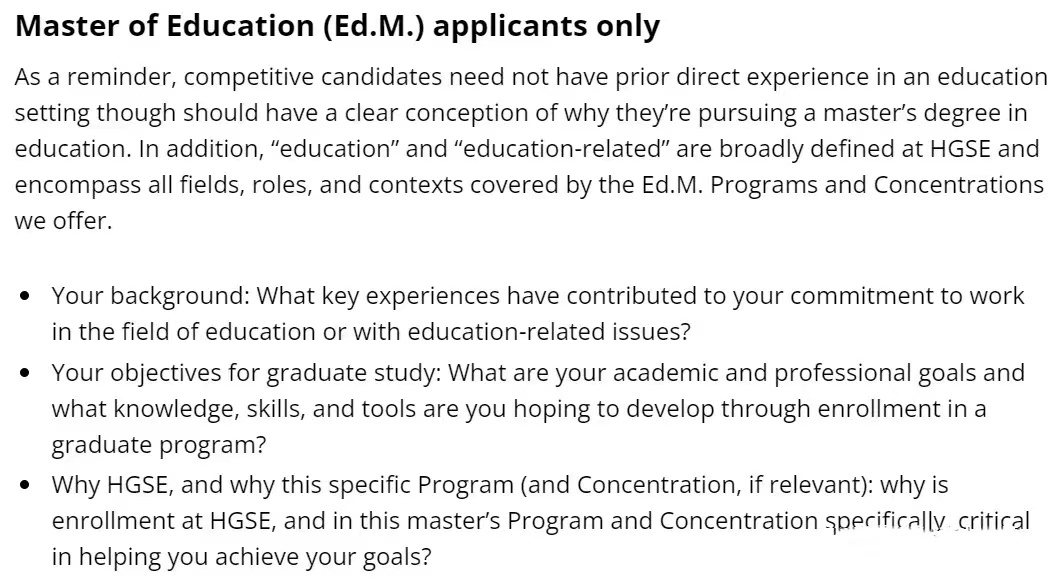
Curriculum
Completing this program requires at least 42 credits:
- Foundations courses: Core courses for all education school students, including
How People Learn, Leading Change, Evidence, Equity and Opportunity. These 4-credit foundational courses require students to begin studying before the fall semester, with How People Learn typically completed online in June.
- Research methods and applied professional skills courses: Required courses totaling 4 credits, covering research methods and skills such as statistics and data science related to education.
- Human development, age/context/domain-specific courses: Include courses such as early childhood development, developmental psychology, preventive and developmental group counseling, and college student development, which can be selected based on the student’s future career planning.
- The HDE Program Core Experience: Unique courses for the Human Development and Education program. In addition to coursework, this component provides opportunities for group practice, experiencing professional work, and engaging in career planning.
Beyond this, the remaining credits are fulfilled through electives, and the school offers a wide range of tracks and concentrations for students to choose from:
- Arts and Learning
- Early Childhood
- Global, International, and Comparative Education
- Higher Education
- Identity, Power, and Justice in Education
- Literacy and Languages
As long as students have a clear plan for after graduation, these courses can fully meet their needs for employment or further doctoral studies in various fields.
For example, for students who want to work in higher education institutions in research or administrative roles, the Higher Education track is an excellent fit; for those aiming to enter government agencies or non-governmental organizations, the Global, International, and Comparative Education track offers relevant courses in education policy, teaching, or organizational leadership, which can be very helpful. The school also provides different direction choices based on career goals:
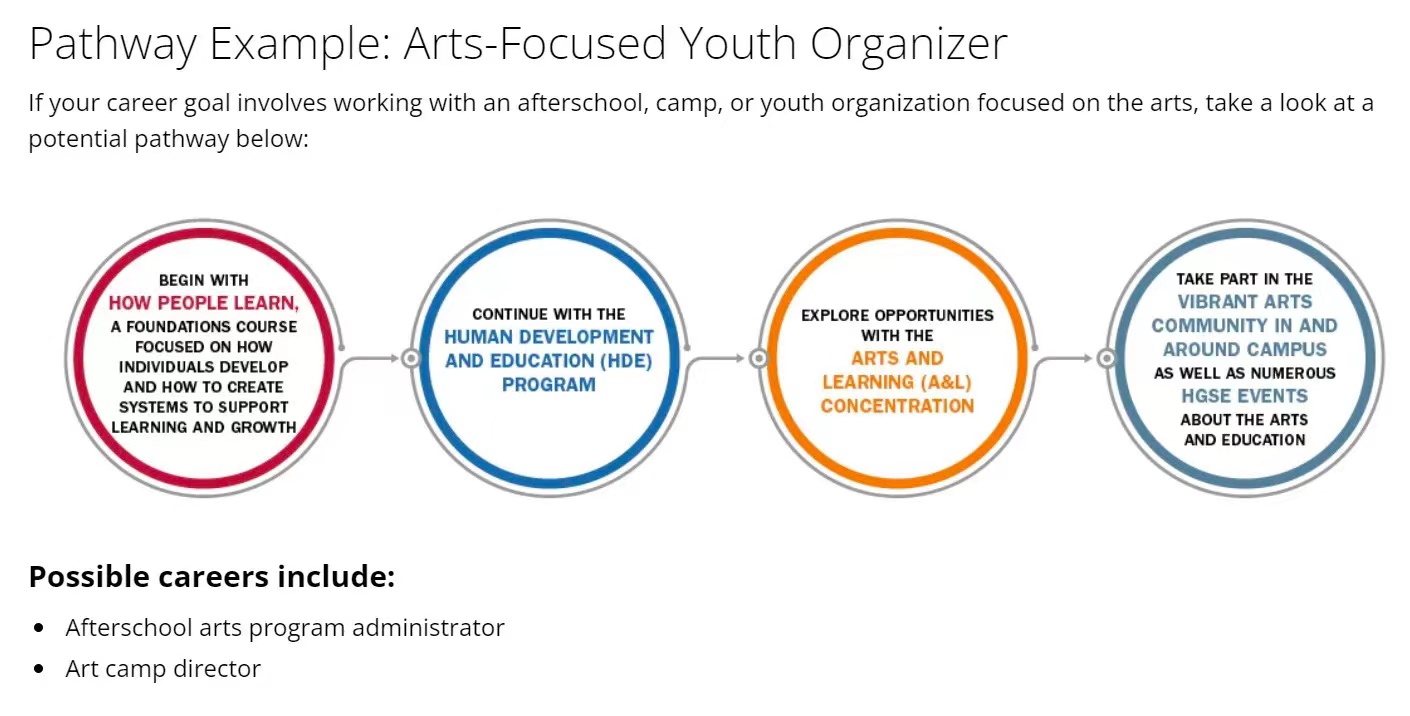
As can be seen, Harvard has put considerable thought into its curriculum, covering essentially all advanced requirements for post-graduation employment or further academic pursuits.
Careers:
According to official school data, graduates of this program typically find suitable employment in education, educational research, and government/non-governmental organizations.
Additionally, the HDE program offers a course plan for obtaining a Massachusetts school counseling license, which is a great option for students wishing to work in the U.S. after graduation. However, it is important to note that this track must be selected at the time of applying to the HDE program.
Columbia University Master’s in Developmental Psychology
The Developmental Psychology program is offered through Columbia’s Teachers College (TC)
.png)
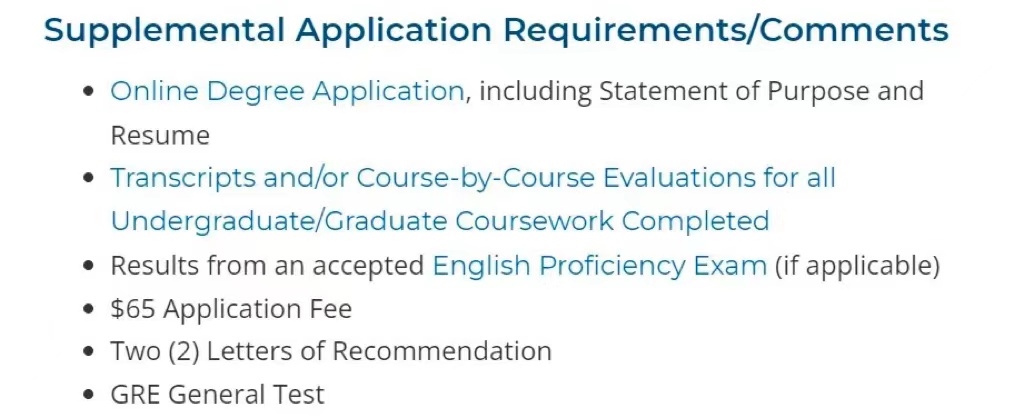
Application Requirements:
GPA: Recommended to maintain 3.7+
GRE: Required; 325+ is recommended
Language Requirements: TOEFL iBT ≥ 100; IELTS ≥ 7.0
Official transcripts
Resume/CV
Two letters of recommendation
One personal statement
Curriculum
The Developmental Psychology master’s program curriculum includes: 5 core courses; 1 statistics course; 2 developmental psychology courses; and a series of elective and practical courses.
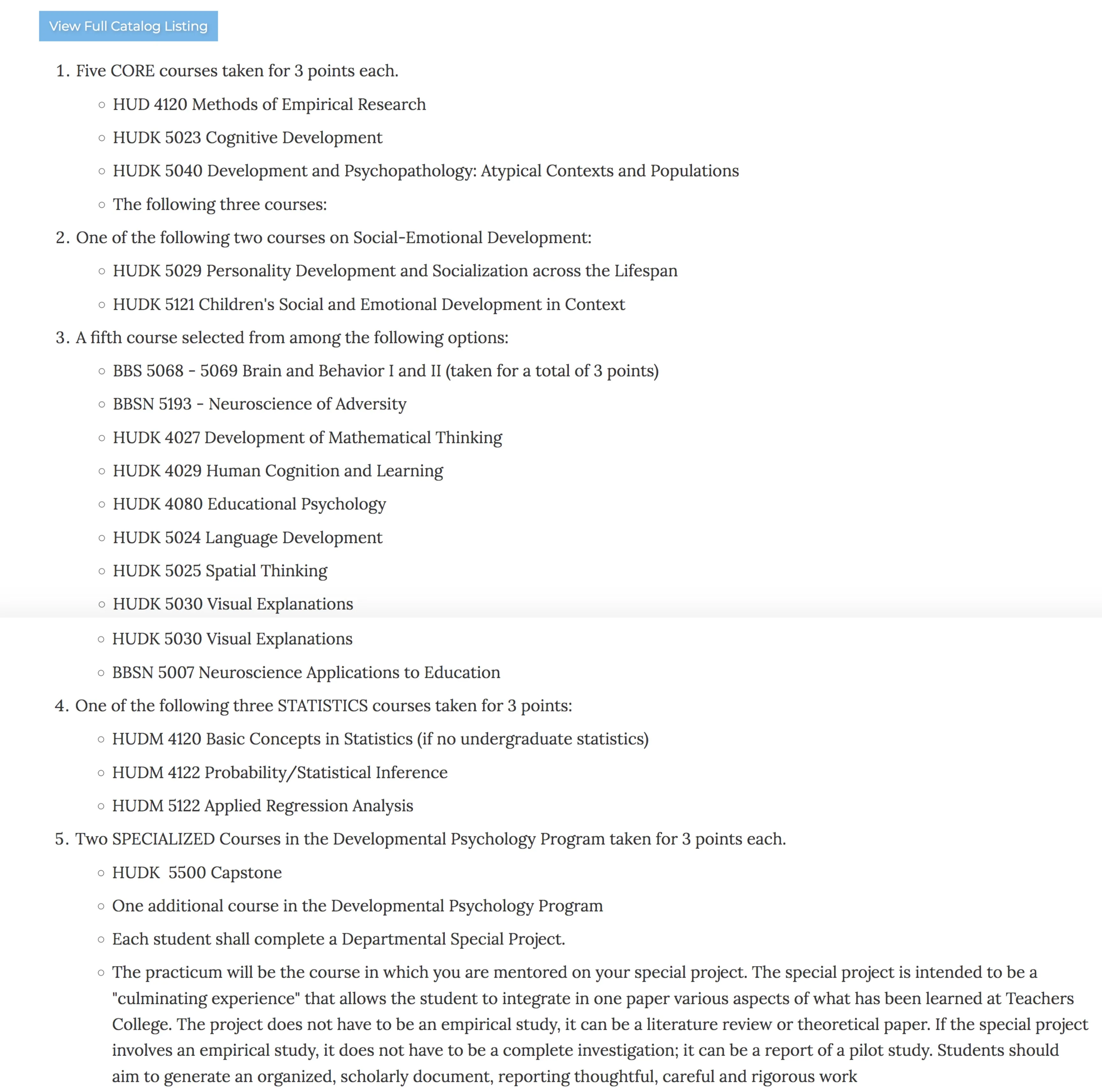
Completing the Developmental Psychology master’s degree requires 32 credits. Looking at the course list, this program offers many courses related to cognition, language, personality, social functioning, and development. Students have a high degree of freedom to select courses suited to their career interests.
Careers:
Based on the curriculum, this program is more career-oriented, making it highly suitable for students who wish to pursue clinical or counseling work in the future. Graduates of this program typically go on to positions in research laboratories, biomedical institutions, education and children’s foundations, or government agencies.
At the same time, Teachers College itself also offers a doctoral program in developmental psychology, and some coursework from the master’s program can fulfill requirements for later Ph.D. applications. This provides an alternative pathway for students who wish to pursue in-depth academic research.
————————————————————————
From the application requirements of these two schools, it is clear that the main challenges in applying for U.S. psychology master’s programs lie in GPA competition and soft skills. GPA requires sustained hard work throughout undergraduate studies, while soft skills can be enhanced within a year through relevant academic or internship experiences. Generally, one or two research and internship experiences aligned with the application direction can significantly improve your chances of admission.
In terms of future employment, the most common career path for psychology graduates is psychological counseling, which offers high income and good development prospects. Beyond that, graduates can also work in human resources management or market research, such as consumer psychology surveys, media market research, and advertising market research; or engage in research on human-machine interaction.
Attached: 2023 U.S. Psychology Program Rankings for Reference
U.S. Psychology Master’s Ranking Top 1: University of California, Berkeley
Top 3: Harvard University
Top 3: University of California, Los Angeles
Top 3: University of Michigan, Ann Arbor
Top 3: Yale University
Top 7: University of Illinois at Urbana-Champaign
Top 8: Massachusetts Institute of Technology
Top 8: Princeton University
Top 8: University of Minnesota, Twin Cities
Top 8: University of Pennsylvania
Top 8: University of Texas at Austin
Top 13: University of California, San Diego
Top 13: University of North Carolina at Chapel Hill
Top 13: University of Wisconsin–Madison
Top 13: Washington University in St. Louis
Top 17: Carnegie Mellon University
Top 17: Columbia University
Top 17: Duke University
Top 17: Indiana University Bloomington
Top 17: Northwestern University
Top 17: University of Chicago
Top 17: University of Virginia
Above is the 2023 U.S. News Top 20 Psychology Master’s Rankings!
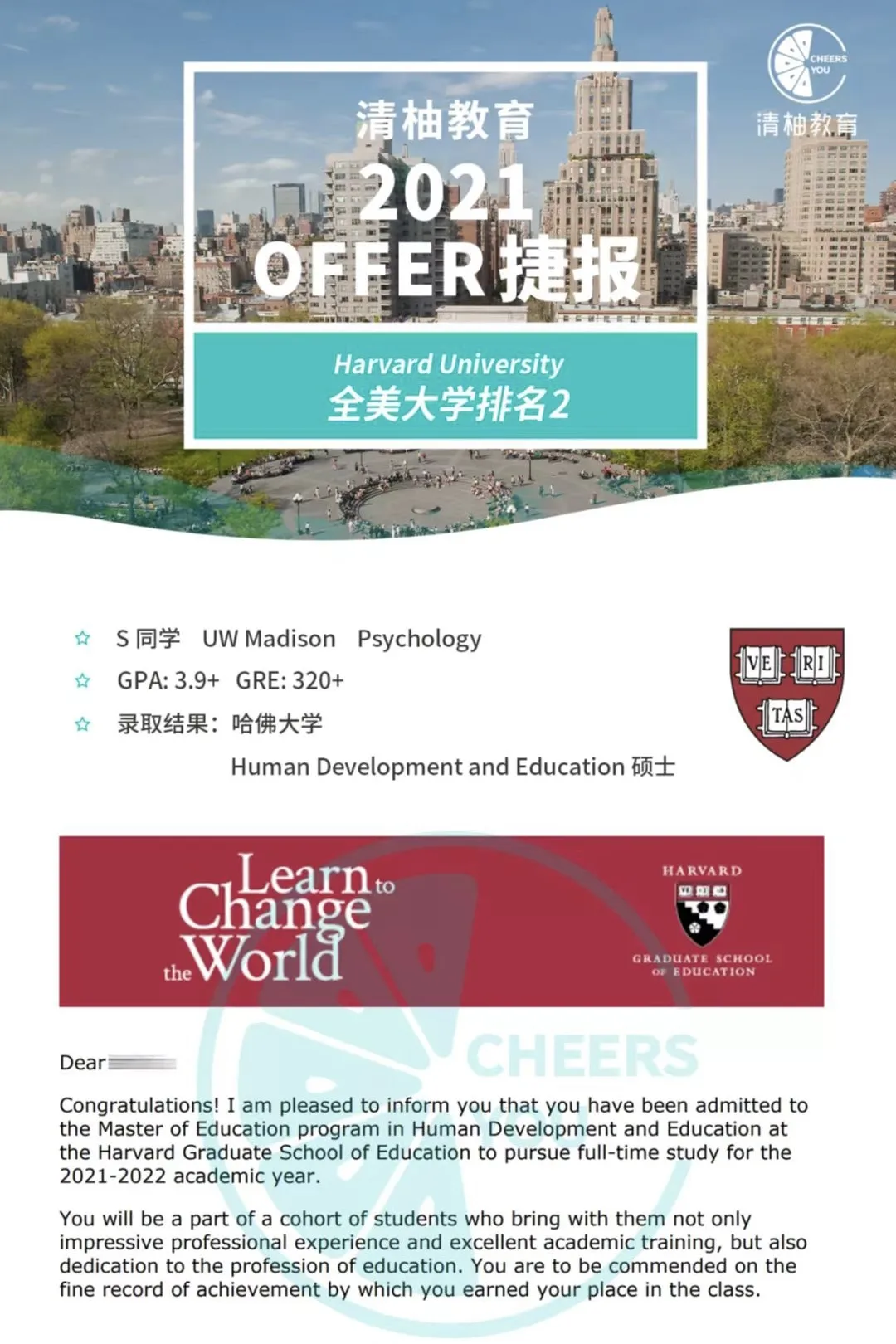
Finally, here are some CheersYou(清柚教育) Students’ Psychology Offers
.jpg?x-oss-process=style/opt-webp)
————————————————————————
If you’re interested in applying for psychology graduate programs, feel free to scan the QR code below to start a one-on-one study abroad consultation~