
What is MIS?
MIS, short for Management Information Systems, is a multidisciplinary field that integrates information science, systems science, management science, and computer science.
This major primarily focuses on the acquisition, transmission, and management of information to facilitate better business decision-making.
In simple terms, MIS is a discipline based on computer science (CS) that applies information technology to business contexts.
Differences Between MIS and CS
CS is Too Hard to Get Into
The popularity of CS has led to a surge in application difficulty for graduate CS programs at top U.S. universities. The admission requirements are extremely high: GPA, academic/school background, GRE/GMAT scores, internships, research/competition experience—almost nothing can be overlooked, and every criterion is demanding.
-
Sufficient CS prerequisite courses
-
The average GPA for admitted CS students is above 3.6, with some schools reaching an average of 3.8. TOEFL averages 100+, and GRE needs to be 320+
-
Impressive personal soft skills, research projects, internships, papers, patents, awards, work experience...
Therefore, for students looking to switch into computer-related fields, the MIS major can serve as a “circuitous route” to achieve their goals.
MIS Isn’t Just About Coding
MIS is an interdisciplinary field of computer science and business. Programming is only a small part of the curriculum, and many MIS-related jobs don’t require you to code. The core of most MIS work focuses on data analysis, teamwork, leadership, project management, customer service, and fundamental business theory.
The following table compares MIS and CS:
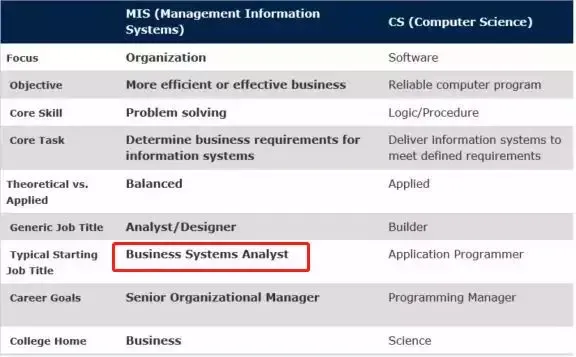
(Screenshot from Eller)
As shown in the figure, the MIS major also suits students with a business background. For example, accounting students transitioning to MIS can pursue careers in Big Four areas such as Deloitte Digital, Tech. Strategy & Architecture, Application Mgt. Services, Customer Solution, and Oracles/SAP Package Tech.
Additionally, MIS programs are STEM-designated, offering three years of OPT in the U.S., and the employment outlook is quite optimistic.
MIS Covers a Wide Range of Fields
MIS programs generally fall into two categories: one is more technical, with curriculum and careers leaning toward CS;
The other is more business-oriented, with courses emphasizing strategy/management and careers leaning toward business analysis. Product managers at tech companies, consultants at Big Four firms, and business analysts at financial institutions are all options for MIS graduates.
MIS mainly involves the following professional areas:
-
Information Systems: including Data Communication, Database, Programming Language, Client/Server Computing, System Analysis and Design, etc.
-
Management Sciences: including Mathematical Programming, Optimization, Operation Research, etc.
-
Production and Operations Management: including Decision Theory, Organization Theory, etc.
-
Statistics
-
Other fields: including Marketing, Finance, Management, Accounting, Business Law, Economics, etc.
Let’s look at the curriculum of NYU’s MIS program:
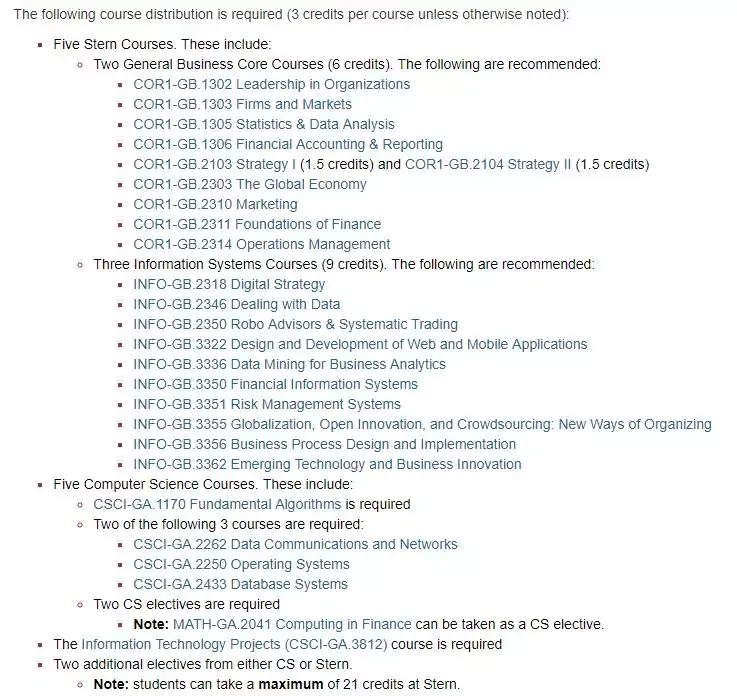
(Curriculum)
(NYU’s MIS program is housed under the Department of Mathematics, but teaching is jointly delivered by the Mathematics Department and the Stern School of Business. Half of the program requires mathematics courses, and the other half requires business school courses.)
Summary
Although MIS is not as technically intensive as CS in terms of curriculum, it offers even more flexibility in terms of school choice and career direction. Whether it’s the West Coast tech hubs or the East Coast financial centers, MIS professionals are needed.
If you are passionate about programming and your career goal is to become a programmer or pursue other technical roles, then by all means apply for CS programs.
If you feel you are not so “technical” but still want to acquire and improve technical skills, while also being interested in business and enjoy communicating with people, then a business-oriented MIS program is a very suitable choice for you.
How to Apply for an MIS Program?
In terms of application requirements, MIS programs require attention to prerequisite courses and work experience background.
Prerequisite Course Requirements
Although there is no specific major requirement for applicants, schools offering MIS programs generally have prerequisite course requirements. They usually expect applicants to have a certain foundation in computing, having taken courses such as network programming, databases, statistics, accounting, calculus, etc. Requirements vary by school.
The minimum prerequisite background for NYU’s M.S. in Information Systems program includes:

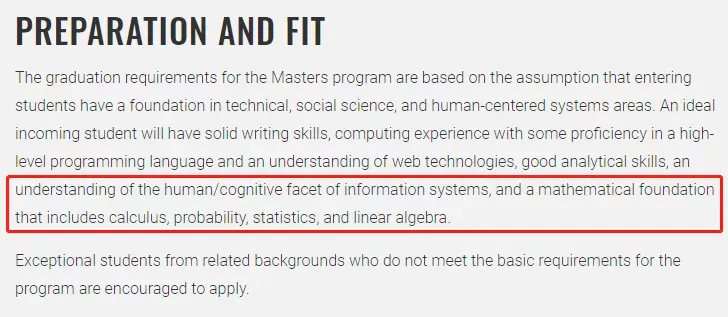
Cornell Master of Professional Studies program background requirements: Mathematics foundation, including calculus, probability, statistics, and linear algebra;
CMU Master of Information Systems Management prerequisite course requirements:
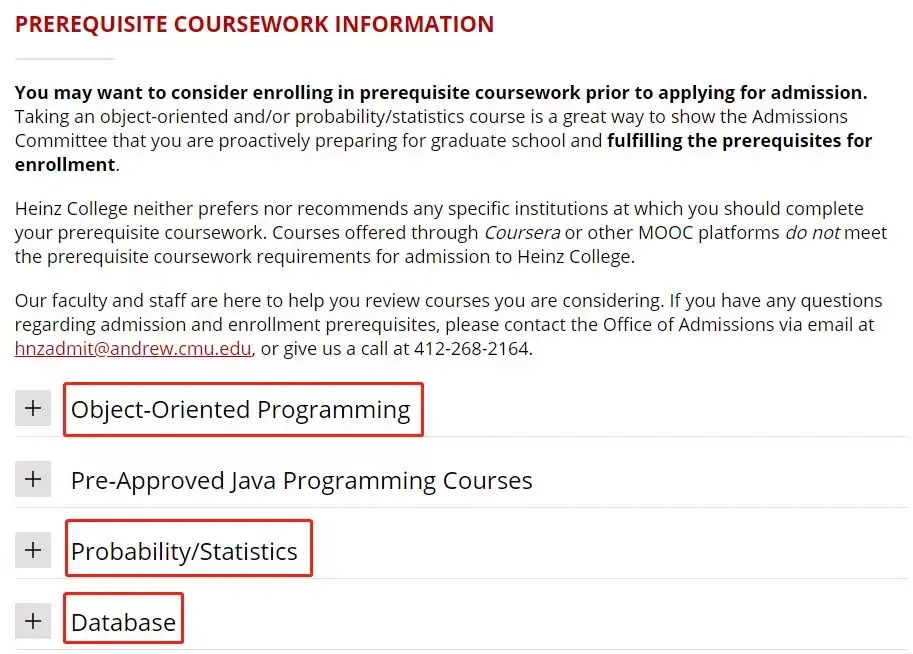
Background Requirements
Although MS in MIS programs do not strictly require work experience, it has been proven that applicants with work experience have an advantage. It is therefore recommended that applicants, especially current students, highlight practical experience through internships.
NYU MIS program work experience requirement for entry:

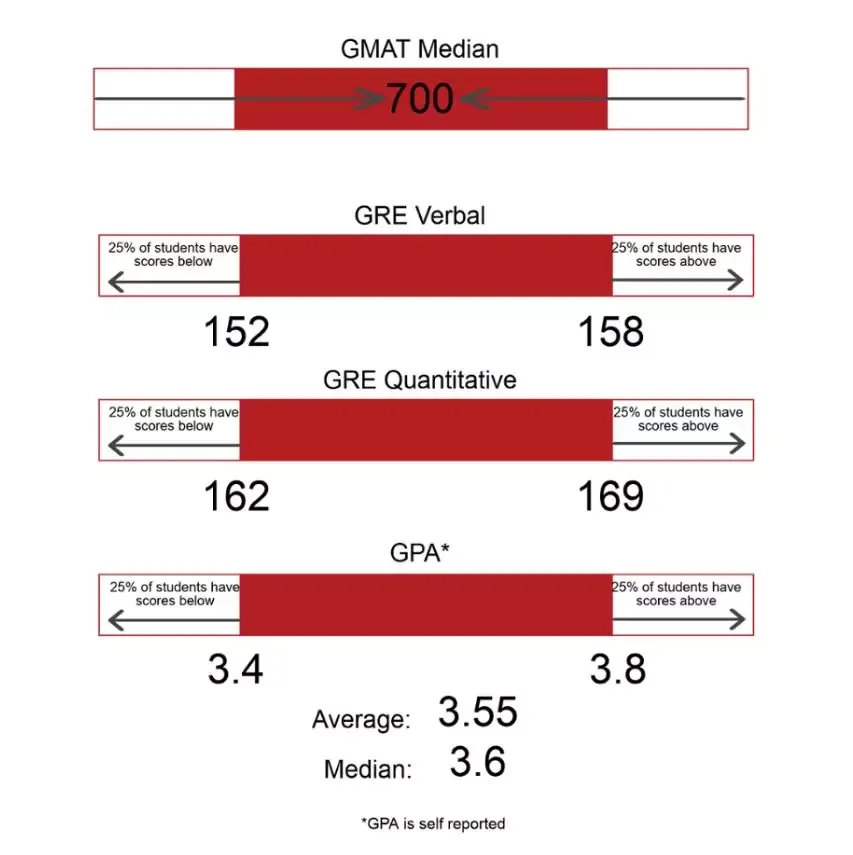
Regarding application scores, let’s look at the admission score range for CMU MISM:
Which schools offer MIS-related master’s programs?
Many schools in the U.S. offer master’s programs in management information systems, but the names may vary. Some programs are even a combination of two separate majors (e.g., Purdue University’s Business Analytics and Information Management program). Therefore, when choosing schools, it’s essential to fully understand the curriculum and specialization tracks of each program.
1. MIT :
Sloan School of Management - System Design & Management
2. Carnegie Mellon University:
Heinz College of Information Systems and Public Policy - Information Systems & Management
3. NYU:
NYU Courant Institute of Mathematical Sciences- Information Systems
4. University of Minnesota-Twin Cities:
Carlson School of Management -Information & Decision Sciences.
5. University of Washington (Seattle):
Foster School of Business - Information Systems
6. University of California (Berkeley):
School of Information - Information Management and Systems/Information and Data Science/Information and Cybersecurity
7. Johns Hopkins University:
Carey Business School - Information Systems
8. George Washington University:
School of Business - Information Systems Technology
9. University of Florida:
Warrington College of Business - Information Systems and Operations Management
10. Purdue University:
Krannert School of Management - Business Analytics And Information Management
(Incomplete list)
Below are introductions to some specific MIS-related master’s programs:
Carnegie Mellon University
CMU’s information management program is offered under the Heinz College of Information Systems and Public Policy, with the program named Management Information Systems.
The program emphasizes IT practices and business methods. The school pays close attention to the application of theoretical knowledge in practice, emphasizing students’ technical abilities. Accordingly, the academic pressure is relatively high, but graduates are highly sought after in the job market, with promising employment prospects.
Massachusetts Institute of Technology
MIT’s information systems management program is under the Sloan School of Management, with the program named System Design & Management.
The SDM curriculum leans toward engineering, with core courses related to system design, such as system architecture, systems engineering, and system project management. The school’s admission requirements strictly require work experience—technical-level work experience along with management experience is needed.
University of Minnesota-Twin Cities
The University of Minnesota-Twin Cities’ information management program is under the Carlson School of Management, called Information & Decision Sciences.
IDS focuses more on the practical application of management information systems. For example, courses cover enterprise management information systems, e-commerce, information security, and advanced database design. The curriculum is quite similar to the MIS program offered by Chinese universities, mostly leaning toward foundational disciplines.
MIS Career Directions
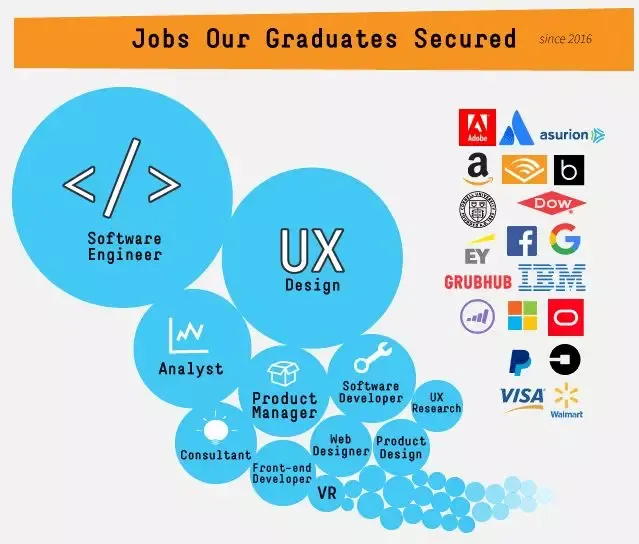
Virtually every large company has its own MIS department. Graduates are well-suited for positions related to information management at information management companies, internet companies, and other commercial enterprises, such as state-owned enterprises, private enterprises, Sino-foreign joint ventures, and wholly foreign-owned enterprises. Roles include senior consultant, project manager, programmer, and system analyst.
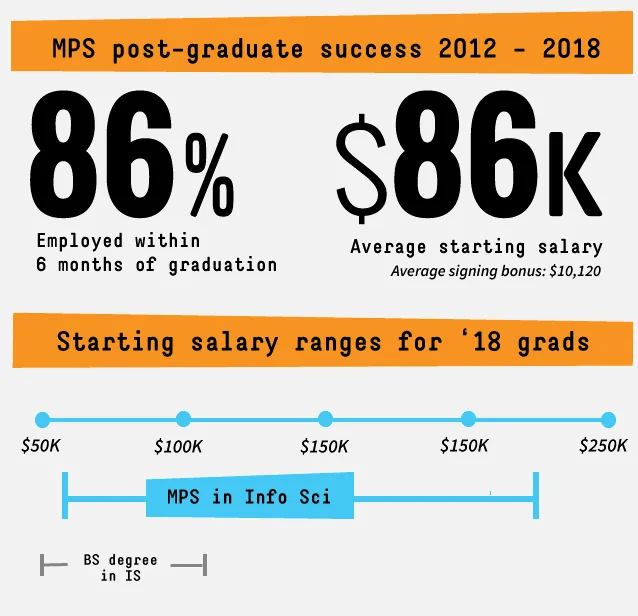
For Cornell MPS program graduates from 2012 to 2018, 86% of students found jobs within six months of graduation, with an average salary of $86k.
Starting salary for MPS graduates is $50K, and the growth trend is clearly visible from the chart.
CheersYou(清柚教育) Advice
1. Understand whether your academic background suits a business-oriented or technology-oriented program. Students with less strong backgrounds in computer science/math are better suited for MIS programs housed in business schools. Students with a computer science background may consider Information Science programs.
2. Different programs require different standardized tests. Generally, MIS programs under business schools accept either GMAT or GRE, but many MIS programs only accept GRE scores.
3. MIS program lengths are 1 or 2 years. Students with weaker computing backgrounds can opt for 2-year programs, as 1-year programs can create immense pressure and leave insufficient time to fill gaps in programming skills (Python, R, Oracle, etc.).
That’s it for today’s introduction to MIS. When choosing a program, consider not only your background direction but also geographic location carefully. If you have any questions, feel free to consult a CheersYou(清柚教育) advisor~