Poets&Quants recently released its 2020-2021 ranking of full-time MBA programs at U.S. business schools. This ranking is widely accepted by American universities and companies and carries significant influence.
P&Q is a well-known U.S. education website that has for years focused on reporting business education news and producing rankings across various metrics. For MBA applicants, both domestic and international, the P&Q ranking remains one of the most reference-worthy and authoritative rankings available.
Today, CheersYou(清柚教育) will interpret this ranking. Let’s take a look at how the turbulent year of 2020 has impacted the rankings of MBA programs!

Ranking Methodology
Generally, P&Q combines:
- USNews (weighted 35%)
- Forbes (weighted 25%)
- Financial Times (weighted 15%)
- Businessweek (weighted 15%)
- The Economist (weighted 10%)
the five most influential and authoritative rankings, assigns weights, performs calculations, and produces the final ranking.
However, due to the impact of COVID-19 this year, Businessweek decided not to publish its ranking. The Economist also postponed its ranking release, and Stanford University, Harvard University, the Wharton School, MIT, the University of Chicago, Kellogg School of Management, and Columbia University did not participate in rankings because of the pandemic.
Therefore, this year's P&Q ranking uses Businessweek and The Economist rankings published in 2019-2020 to help reflect the overall standing of each business school.
P&Q's ranking is more stable and reliable than most other organizations' rankings. In this year’s list, only 11 MBA programs saw ranking changes of 10 or more spots compared to last year.
Ultimately, 250 universities from 43 countries and regions made the list.
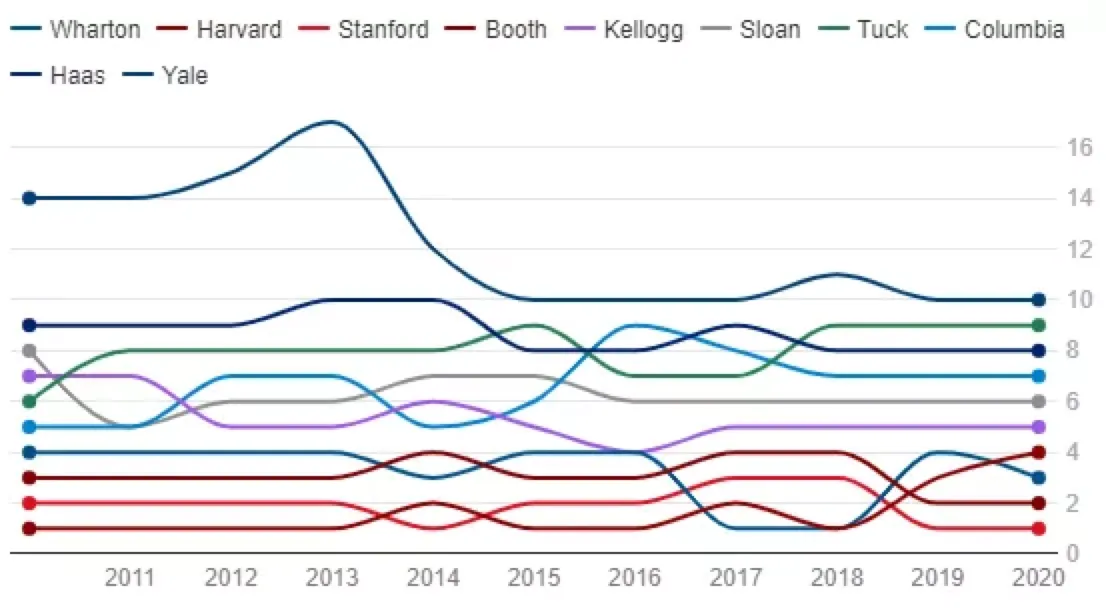
Top 50 Ranking Overview
Top 25: Stanford Tops for Second Year, Harvard Falls to Record Low
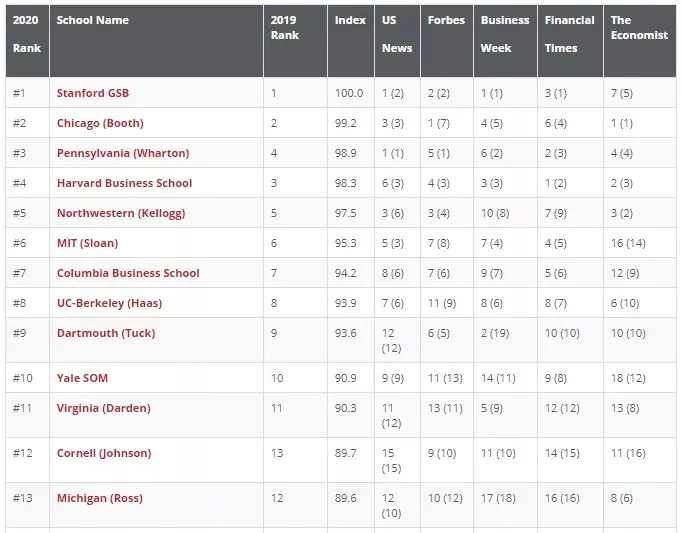
Stanford's Graduate School of Business retained the No. 1 spot on Poets&Quants' ranking of the best U.S. MBA programs for the second consecutive year. All 10 schools from last year's top 10 remained on the list.
Overall rankings shifted, but changes were generally modest. This year, Harvard Business School dropped to its lowest-ever ranking, slipping one spot from last year to fourth place.
This year’s top three MBA programs are Stanford University (No. 1), the University of Chicago Booth School of Business (No. 2), and the University of Pennsylvania's Wharton School (No. 3).
Harvard and Northwestern University followed in 4th and 5th places, respectively. Rounding out the top 10 are MIT, Columbia University, UC Berkeley, Dartmouth College, and Yale University.
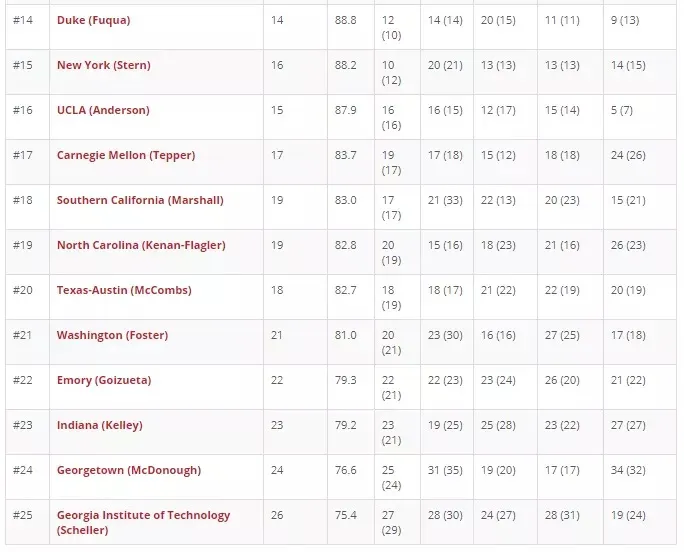
Top 50: Higher MBA Acceptance Rates, Rice University Drops Out of Top 25
Schools in the second tier tend to have higher acceptance rates and are relatively easier to get into compared to top-25 schools.
Because most of these schools do not offer the optimal MBA experience, they are often underestimated and overlooked by applicants.
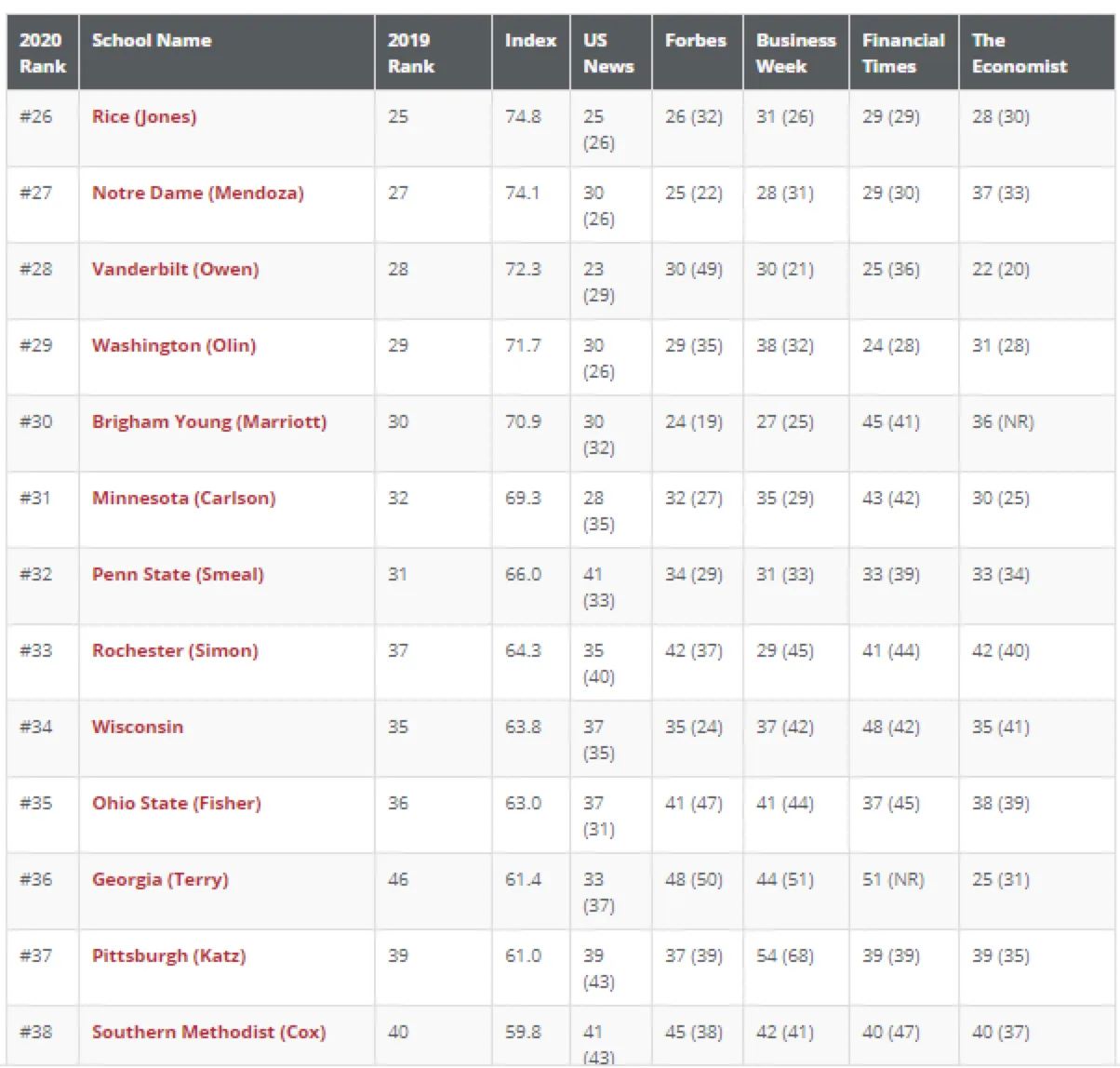
Rice University dropped one spot from last year, falling out of the top 25. Meanwhile, George Washington University broke into the top 50 this year.
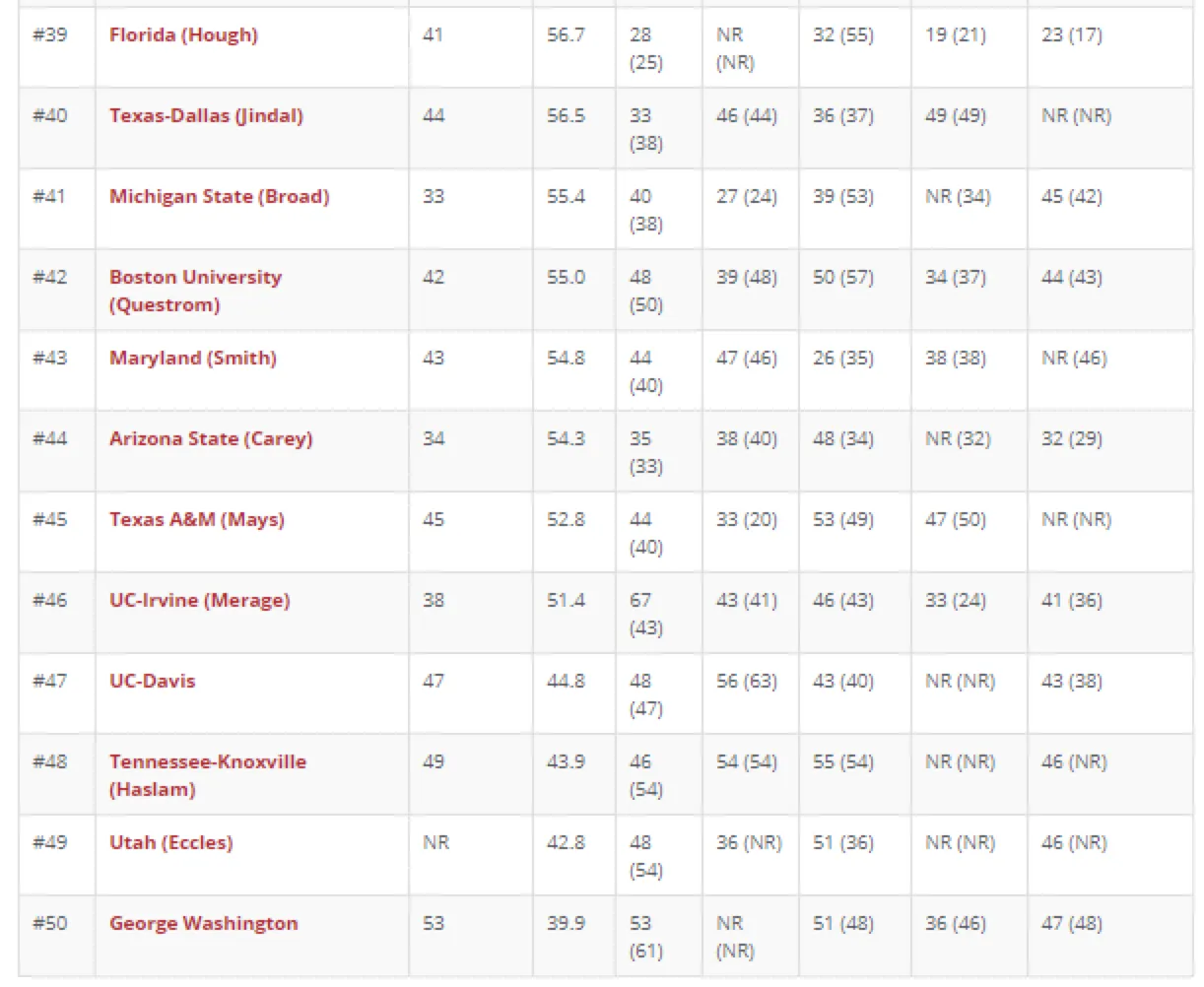
Ranking Analysis
Basis for Ranking Changes
The P&Q ranking also captures and analyzes extensive data from various major rankings. This includes survey data from corporate recruiters, MBA graduates, deans, and faculty, as well as median entering student GPAs and GMAT scores, and the latest salary and alumni employment statistics, all of which factor into the assessment.
Through this list, students can observe year-over-year changes across different rankings and see at a glance where their target schools stand in core rankings.
Schools with Double-Digit Ranking Shifts
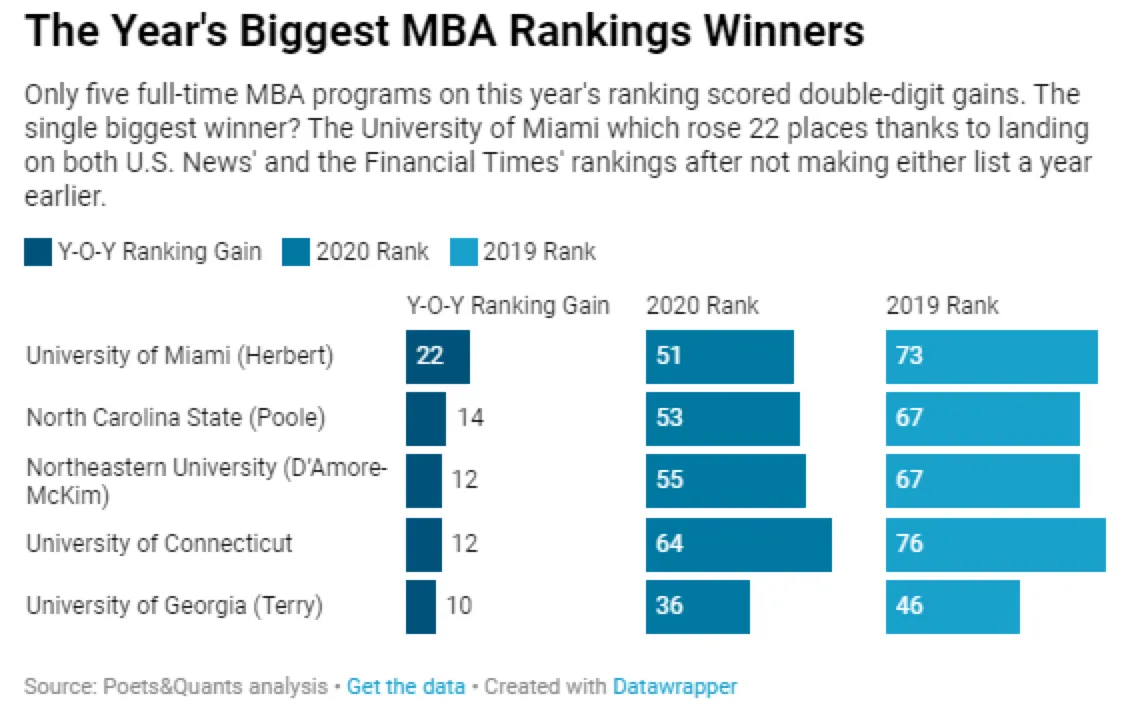
In this year's ranking, only five full-time MBA programs saw double-digit improvements: the University of Miami, North Carolina State University, the University of Connecticut, Northeastern University, and the University of Georgia.
The biggest winner is the University of Miami, now ranked 51st, which climbed 22 spots. This is because Miami was not included in last year's USNews and Financial Times rankings.
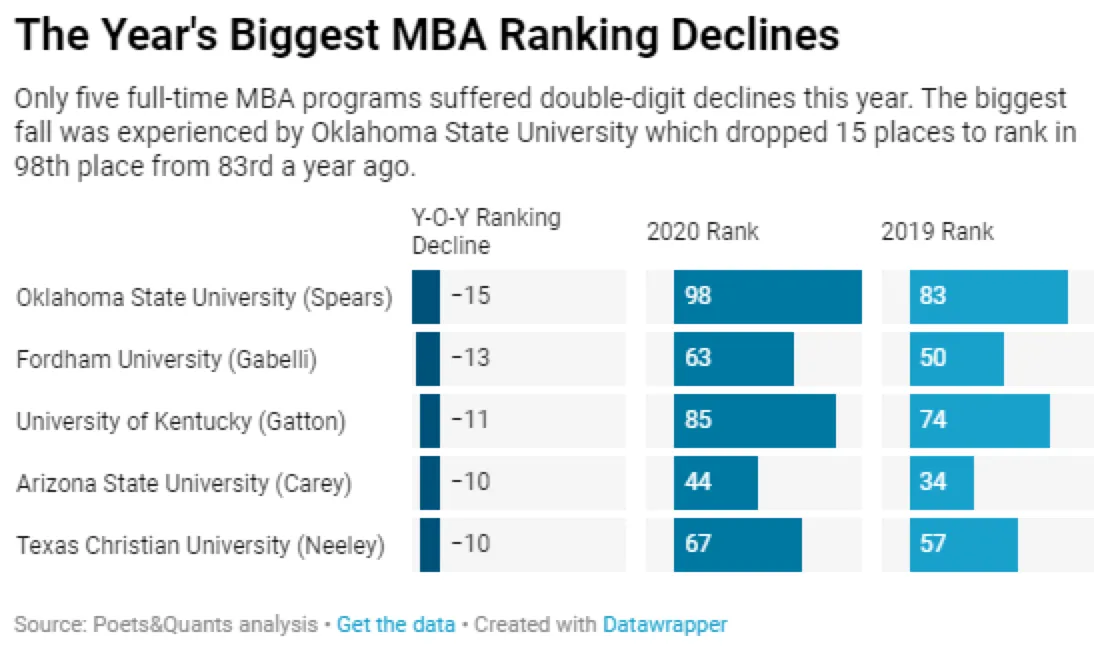
This year, only five full-time MBA programs saw double-digit drops: Oklahoma State University, Fordham University, the University of Kentucky, Arizona State University, and Texas Christian University.
The steepest decline was at Oklahoma State University, which fell 15 spots from 83rd a year ago to 98th.
Hidden Gem MBA Programs
Among schools ranked 51-75, there are often hidden gem MBA programs. At these excellent business schools, the programs are smaller and more intimate. Though they may not have influential rankings in all five authoritative lists, they still enjoy strong reputations.
For example, Northeastern University at 55th is a cradle for many outstanding entrepreneurs in Boston, while Fordham University serves as a direct path to education and employment in New York City. Howard University, ranked 69th, is one of the few historically black colleges and universities and a top-100 MBA program.
It is essential for students to remember that there are over 1,100 accredited full-time MBA programs in the U.S., so any business school on this list is in the top 10% of all U.S. MBA programs.
Schools in the latter half of the top 100 do not necessarily have lower admission standards. In most cases, admissions officers at top-100 MBA programs tend to favor candidates with work experience.
However, smaller and lower-ranked schools are often more willing to accept recent graduates into their MBA programs, may offer generous financial support, and have significantly lower tuition than higher-ranked schools.
The complete P&Q 2020-2021 MBA program ranking can be found at:
When choosing schools in the future, students can use this P&Q 2020-2021 MBA program ranking as a reference to maximize the return on their study abroad investment.
Rankings are for reference only. Rankings should not be the sole basis for university application decisions.
When selecting target universities, students should view various rankings rationally and combine their own background and various personal needs to make a more reasonable and individualized choice.